


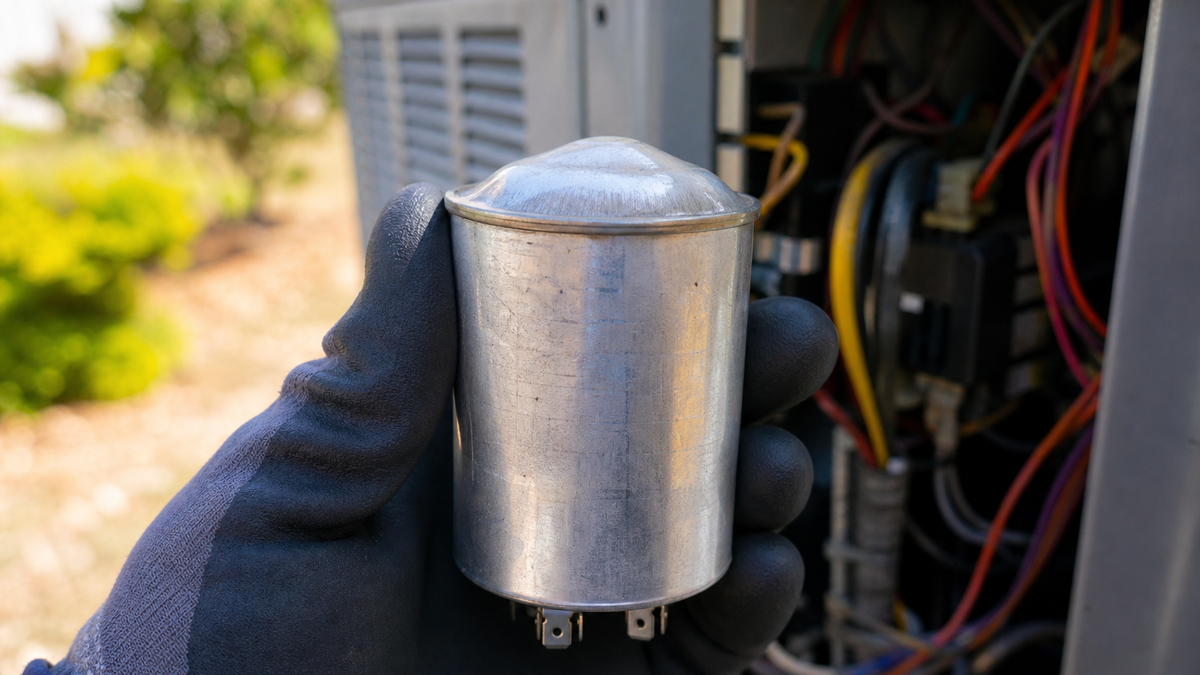
Symptoms of a Bad AC Capacitor: 8 Signs to Watch For
Symptoms of a Bad AC Capacitor: 8 Warning Signs to Watch
If your air conditioner hums but won't kick on, the most likely culprit is a failed capacitor. The symptoms of a bad AC capacitor are usually easy to spot once you know what to listen and look for: a humming outdoor unit that never starts, warm air from the vents, a condenser fan that spins slowly or sits still, and a sudden jump in your energy bill.
The good news is that a capacitor is one of the cheapest parts of your AC system to replace. Catching the warning signs early can protect your far more expensive compressor.
We service homes across St. Petersburg and the rest of Pinellas County, and in the heat of a Florida summer the capacitor is the single part we replace most often. Below we walk through the eight clearest symptoms of a bad AC capacitor, what causes them, what you can safely check yourself, and roughly what a replacement runs.
One thing first: a capacitor stores a powerful electrical charge even after the power is off, so this is a repair to leave to a licensed technician.
What an AC Capacitor Does (and Why It Fails First in Florida)
Think of the capacitor as the battery that gives your AC motors the jolt they need to start. Your outdoor unit has two motors that draw a lot of power: the compressor and the condenser fan. They cannot pull enough current from the wall to overcome their own inertia. The capacitor stores energy and releases it in a quick burst to get them spinning. A second "run" charge keeps those motors turning smoothly while the system cools your home.
Most central AC systems use a single "dual run" capacitor that handles both the compressor and the fan. It is a small cylindrical can tucked inside the access panel of the outdoor condenser. When it weakens, the motors lose their starting punch, and every symptom on this list traces back to that lost jolt.
Florida is hard on capacitors. They are heat-sensitive components, and our long cooling season means your AC may run eight to ten months a year, often for hours at a stretch. Add frequent summer thunderstorms and the power flickers that come with them, and you have the perfect recipe for early capacitor failure. That is why, in our experience servicing Pinellas County homes, a bad capacitor is the most common reason a unit quits during a July heat wave.
Safety note: A capacitor can hold a dangerous, even lethal, electrical charge for a long time after you shut off the power. Never open the electrical compartment of your condenser or touch the capacitor terminals. Diagnosing and replacing one safely takes proper tools and training.
8 Symptoms of a Bad AC Capacitor
Capacitors usually give you warning before they die completely. Here are the eight symptoms of a bad AC capacitor, ranked roughly from the most common and obvious to the more subtle early warnings.
| # | Symptom | What You'll Notice | Urgency |
|---|---|---|---|
| 1 | Humming but won't start | Outdoor unit buzzes, nothing spins | High |
| 2 | Warm air from vents | Air blows but never gets cold | High |
| 3 | Slow or stopped fan | Top fan barely turns or sits still | High |
| 4 | Clicking or buzzing | Repeated click from the condenser | Medium |
| 5 | Short cycling | System turns off on its own | Medium |
| 6 | Higher energy bills | Bill climbs with no usage change | Medium |
| 7 | Burning smell or bulging | Odor, swollen top, oily residue | Call now |
| 8 | Delayed start | Lag after the thermostat calls | Early sign |
1. AC Hums but Won't Start
This is the textbook sign of a dead capacitor. You hear a low electrical hum coming from the outdoor unit, but the compressor and fan never engage. What you are hearing is the motor straining to start without the burst of energy the capacitor is supposed to provide.
The condition is often described as "ac humming not starting," and it is one of the clearest symptoms of a bad AC capacitor. If you hear that hum, shut the system off at the thermostat so the motor does not sit there overheating, and call a technician.
2. Warm Air Coming From the Vents
If your blower keeps pushing air through the vents but it never cools down, a weak capacitor on the compressor side may be the reason. The indoor fan can run fine on its own circuit while the outdoor compressor, which actually removes heat, fails to start. The result is plenty of airflow and zero cooling.
Warm air has several possible causes, so it helps to rule out the simple ones first. Our guide on AC not blowing cold air walks through the full checklist, but if the outdoor unit is also humming or silent, the capacitor jumps to the top of the suspect list.
3. The Outdoor Fan Spins Slowly or Not at All
The fan on top of your condenser is supposed to spin briskly the moment the system starts. When the fan side of the capacitor weakens, that fan may turn slowly, stop and start, or refuse to move at all while the unit hums.
You might be tempted to give the blades a nudge to get them going, but please do not. That old "stick test" puts your hand inches from live electrical components and spinning metal, and it only confirms what a technician can verify safely in a couple of minutes. A stopped fan also lets the compressor overheat fast, so turn the unit off and call for service.
4. A Clicking or Buzzing Noise From the Condenser
A repeated clicking or buzzing from the outdoor unit often means the system is trying to start and failing. The contactor and relay click as they call for the motors to fire, but without a healthy capacitor the motors never catch, so the cycle repeats.
A faint hum or buzz layered under the clicking points even more strongly toward a capacitor that has lost its charge. These sounds are your AC telling you it is struggling, and ignoring them usually leads to a full no-cool breakdown.
5. The System Shuts Off on Its Own (Short Cycling)
When a capacitor is on its way out, the compressor has to work much harder to start and run. That extra strain makes the motor run hot, and a built-in overload switch shuts it down to protect it. A short while later the unit tries again, overheats again, and shuts off again.
This stop-start pattern is called short cycling. It hammers your equipment, fails to cool your home evenly, and is a strong sign that an electrical component like the capacitor is failing. A struggling capacitor can also stress the compressor, and you can read more about those signs in our guide to AC compressor warning signs.
6. Higher Than Normal Energy Bills
A motor fighting a weak capacitor draws more electrical current than it should. You may not hear or see anything dramatic, but you will feel it on your power bill. If your usage habits have not changed yet your summer bill creeps up, an aging capacitor forcing your compressor to work overtime is one possible cause.
In Florida, where cooling already drives a big share of the monthly bill, even a small drop in efficiency adds up quickly. A spiking bill paired with any of the other symptoms here is worth a service call.
7. A Burning Smell or Visible Bulging/Leaking
A capacitor that has failed catastrophically can give off a faint burning or chemical odor, and the can itself may swell at the top or leak an oily residue. These are signs the component has overheated internally. If you notice a burning smell from the outdoor unit, or you happen to spot a bulging, blown, or leaking capacitor, treat it as urgent.
Shut the system off at the breaker if you can do so safely from outside the panel, keep your hands away from the unit, and call a professional right away. This is not a wait-and-see situation.
8. Delayed Start After the Thermostat Calls for Cooling
One of the earliest and easiest-to-miss symptoms is a lag between the moment your thermostat calls for cooling and the moment the outdoor unit actually kicks on. A healthy system responds within seconds. A weakening capacitor causes a hard start, where the motor hesitates before finally catching. Catching this early warning gives you the chance to replace a cheap part on your schedule rather than during an after-hours emergency in the August heat.
Spotting bad AC capacitor symptoms? Get same-day service across Pinellas County.
Killian's Air Conditioning - Licensed & Insured
📞 (727) 591-4776What Causes an AC Capacitor to Go Bad

Capacitors wear out, but several factors speed up the process, and most of them are amplified by our climate. Knowing the causes helps you understand why the symptoms of a bad AC capacitor show up when they do.
- Heat. Capacitors are rated for a maximum operating temperature, and sustained heat shortens their life. A black condenser sitting in full Florida sun runs hot, which is one reason capacitors here often fail sooner than the textbook lifespan.
- Age and runtime. A capacitor typically lasts several years, but our long cooling season piles on the operating hours. Heavy use brings many units to the lower end of their expected life.
- Power surges and lightning. Tampa Bay sees frequent summer thunderstorms, and the voltage spikes that ride along with them can degrade or instantly destroy a capacitor.
- A wrong-size replacement part. A capacitor must match the motor's specifications. An incorrect microfarad or voltage rating makes the motor run hot and burns the new part out early, which is one more reason to have the right part installed by a pro.
- Normal wear. Even under ideal conditions, the materials inside a capacitor break down slowly over time. Eventually every capacitor reaches the end of its service life.
Routine maintenance catches a weak capacitor before it strands you. During a tune-up, a technician measures the capacitor's actual output against its rating and replaces it proactively if it is drifting. Our overview of AC maintenance that prevents breakdowns explains how a yearly visit heads off exactly this kind of summer failure.
Can You Check a Capacitor Yourself? Safety First
Here is the honest answer: you can safely confirm the symptoms, but you should not open the unit or touch the capacitor. A charged capacitor can deliver a serious, potentially fatal shock even after the power has been off for a while, because it stores energy by design. Testing and replacing one requires a meter, the knowledge to safely discharge the component, and the correct replacement part. That work belongs to a licensed technician.
What a homeowner can safely do:
- Listen and look from outside the unit. Note whether it hums, clicks, runs warm, or shows a bulging top. Those observations help your technician diagnose faster.
- Check your thermostat and breaker. Make sure the thermostat is set to cool and the breaker for the AC has not tripped. Resetting a tripped breaker once is fine; if it trips again, stop and call for service.
- Replace a dirty air filter and clear debris. A clogged filter or leaves packed against the condenser can mimic or worsen cooling problems. Keeping them clear rules out the simple stuff.
- Shut the system off if you suspect a problem. Running an AC with a failing capacitor only risks damaging the compressor. Turn it off at the thermostat and call a pro.
What you should never do: open the electrical access panel, touch the capacitor or its terminals, attempt to discharge it, or swap it out yourself. The savings are not worth the shock risk, and an incorrectly sized part can damage your motors. When the symptoms point to a capacitor, the safe move is a quick service call.
AC Capacitor Replacement Cost in Pinellas County

The silver lining of a bad capacitor is that it is one of the most affordable AC repairs you will ever face. The part itself is inexpensive, and the job is quick for a trained technician. Costs vary by your system, the type of capacitor, and whether the visit is a standard appointment or an after-hours emergency, so treat the figures below as typical ranges rather than exact quotes.
| Repair | Typical Cost Range | Notes |
|---|---|---|
| Capacitor replacement | Low (one of the cheapest AC repairs) | Part plus labor; quick same-day job |
| Contactor replacement | Low to moderate | Often inspected at the same time |
| Hard start kit | Moderate | Helps a compressor that struggles to start |
| Compressor replacement | High | Far more costly than a capacitor |
The reason we stress replacing a failing capacitor quickly is simple math. A cheap part left to fail forces your compressor, the most expensive component in the system, to work under strain. Letting a known bad capacitor keep running risks turning an inexpensive fix into a major repair.
If your unit is older and you are weighing the cost of repairs, our guide on when to replace your AC unit helps you decide whether to keep fixing or invest in a new system.
When to Call Killian's Air for a Capacitor Problem
If your AC is humming without starting, blowing warm air, short cycling, or showing any of the other symptoms of a bad AC capacitor we covered, do not let it run. Shut it off and reach out. A capacitor is a fast, affordable fix when a licensed technician handles it, and acting early protects your compressor and keeps your home comfortable through the worst of the Florida heat.
As a family-owned, licensed Florida HVAC contractor (FL CAC1823158), we offer same-day service across St. Petersburg, Clearwater, Largo, Seminole, and the rest of Pinellas County. We also stay open 24/7 for emergency service when your AC quits at the worst possible time.
Our EPA and NATE certified technicians carry the common capacitor sizes on the truck, so most of these calls are diagnosed and fixed in a single visit. For a fast no-cool emergency, our emergency AC repair in St. Petersburg team is ready around the clock.
Frequently Asked Questions
What are the most common symptoms of a bad AC capacitor?
The most common symptoms of a bad AC capacitor are an outdoor unit that hums but will not start, warm air coming from the vents, and a condenser fan that spins slowly or not at all. You may also hear repeated clicking or buzzing, notice the system shutting off on its own, or see your energy bill climb.
In more advanced failures, the capacitor can give off a burning smell or visibly bulge. Any one of these signs is worth a service call, and several together strongly point to the capacitor.
Can I run my AC with a bad capacitor?
No, you should not keep running your AC with a bad capacitor. A weak or failed capacitor forces the compressor and fan motors to work much harder to start and run, which makes them overheat and can permanently damage your compressor. Since the compressor is the most expensive part of the system, a small problem can quickly become a major repair. The safest move is to shut the unit off at the thermostat and call a licensed technician.
How much does it cost to replace an AC capacitor?
Capacitor replacement is typically one of the most affordable AC repairs because the part is inexpensive and the job is quick for a trained technician. The exact cost depends on your system, the type of capacitor, and whether you need an after-hours emergency visit. Compared with major repairs like a compressor replacement, a capacitor is a minor expense. Replacing it promptly is far cheaper than letting it strain and damage your compressor.
How long does an AC capacitor last in Florida?
An AC capacitor typically lasts several years, but in Florida it often reaches the lower end of that range. Our long cooling season means the system runs many hours, the heat stresses the component, and frequent summer storms bring power surges that shorten its life. Because of these factors, many Pinellas County homeowners see capacitors fail sooner than the textbook lifespan. A yearly tune-up that tests the capacitor helps you replace it before it leaves you without cooling.
Is it safe to replace an AC capacitor myself?
Replacing an AC capacitor yourself is not safe for most homeowners. A capacitor stores a strong electrical charge even after the power is shut off, and it can deliver a serious or even fatal shock if handled incorrectly. The job also requires a meter to test it, the technique to discharge it safely, and the correct replacement part matched to your motor. For these reasons, capacitor replacement is a job for a licensed, trained technician rather than a DIY project.
What causes an AC capacitor to fail?
Several factors cause an AC capacitor to fail, and most are common in Florida. Sustained heat is a major one, since capacitors are heat-sensitive and our climate keeps them hot for long stretches. Age and heavy runtime wear them out, power surges from summer thunderstorms can damage or destroy them, and an incorrectly sized replacement part will burn out early. Normal material breakdown also brings every capacitor to the end of its life eventually.