
AC Maintenance Tips for St. Petersburg, FL Homeowners
A well-maintained air conditioner costs roughly $75–$200 per year to service — while an emergency AC repair in the middle of July can run $300 to $5,000 or more. For homeowners in St. Petersburg and Pinellas County, where your AC runs 8–10 months out of the year, skipping maintenance isn't just risky — it's expensive.
Here's a quick look at the eight tasks that keep your system running efficiently all summer:
| Task | DIY or Pro? | Frequency | Impact |
|---|---|---|---|
| Replace/clean air filter | DIY | Monthly (cooling season) | Airflow, efficiency, air quality |
| Clear outdoor condenser debris | DIY | Quarterly | Heat transfer, system strain |
| Clean evaporator coil & drain line | DIY/Pro | Twice yearly | Prevents water damage, mold |
| Straighten condenser fins | DIY | Annually | Airflow through condenser |
| Test thermostat accuracy | DIY | Annually | Correct temperature, energy savings |
| Inspect ductwork for leaks | DIY/Pro | Annually | Energy loss reduction (20–30%) |
| Check refrigerant levels | Pro only | Annually | Cooling capacity, compressor health |
| Schedule professional tune-up | Pro | Twice yearly | Full system health, warranty compliance |
Spring is the ideal time to knock these out — before demand spikes and HVAC companies are booked solid through June. Here's exactly what each task involves and how to handle it.
1. Replace or Clean Your Air Filter
Your air filter is the single easiest maintenance task with the biggest payoff. A clogged filter forces your blower motor to work harder, reduces airflow to your home, and can freeze your evaporator coil — all of which shorten your system's lifespan and drive up your electric bill.
In Florida, where most systems run nearly year-round, you should check your filter every 30 days during cooling season (April through October). If you have pets, allergies, or a dusty home, every 3 weeks is better.
How to choose the right filter:
| Filter Type | MERV Rating | Best For | Replace Every |
|---|---|---|---|
| Fiberglass (flat panel) | 1–4 | Basic dust protection | 30 days |
| Pleated | 8–13 | Allergens, pet dander, mold spores | 60–90 days |
| High-efficiency (deep pleat) | 14–16 | Severe allergies, medical needs | 90–120 days |
A MERV 8–11 pleated filter hits the sweet spot for most Pinellas County homes — it captures allergens and mold spores without restricting airflow on standard residential systems. Going higher than MERV 13 without confirming your system can handle the pressure drop can actually cause more harm than good.
To swap it out: Turn off your system, slide out the old filter (note the size printed on the frame), and slide the new one in with the airflow arrow pointing toward the blower. Takes about two minutes.
2. Clear Debris from the Outdoor Condenser Unit
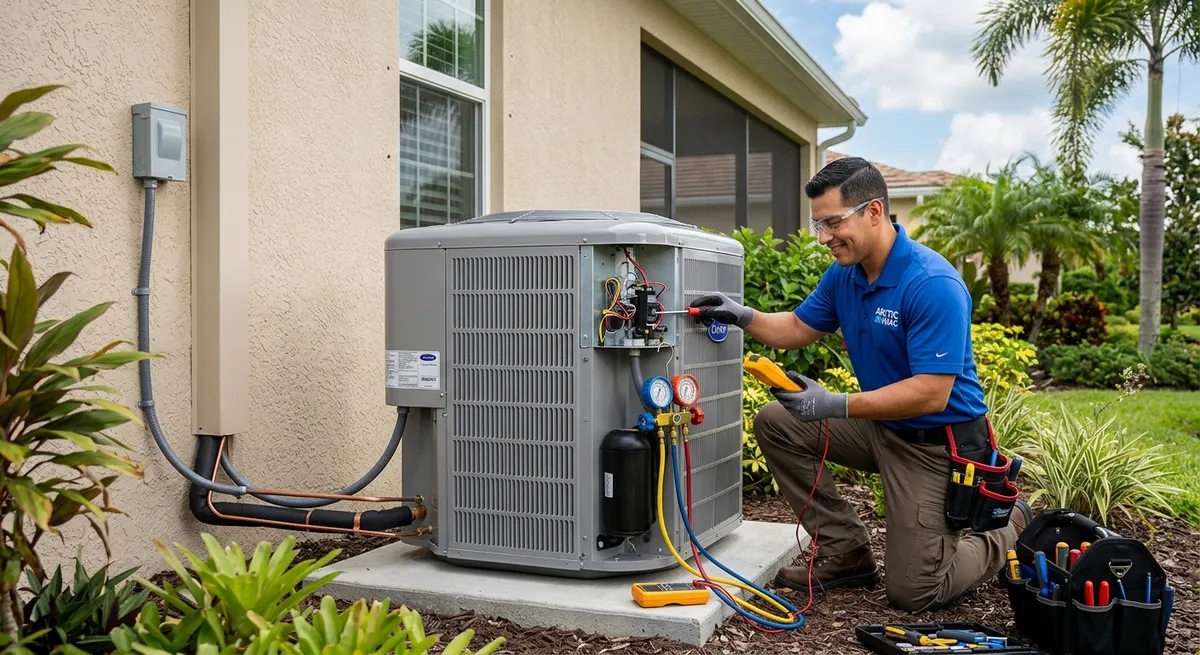
Your outdoor condenser releases heat from your home. When it's clogged with dirt, leaves, or palm fronds, it can't do that efficiently — and your compressor works overtime to compensate.
Keep at least two feet of clearance around all sides of the unit. In St. Pete, that means trimming back oleander, jasmine, or whatever's creeping toward the unit every few months. Florida's pollen season (February through May) and summer storms drop a surprising amount of debris around condensers.
Seasonal cleaning steps:
- Turn off the system at the thermostat and the breaker
- Remove any visible debris — leaves, twigs, palm fronds, grass clippings
- Use a garden hose to spray the fins from the inside out (not a pressure washer — that bends the fins)
- Let the unit dry completely before turning it back on
If the fins look matted with dirt or the unit hasn't been cleaned in over a year, a professional coil cleaning is worth the investment. We see condensers in Clearwater and Largo that haven't been cleaned in three or four years — they're working twice as hard as they need to.
Don't wait for summer breakdowns. Schedule your AC maintenance today.
Killian's Air Conditioning - Licensed & Insured
📞 (727) 591-47763. Clean the Evaporator Coil and Drain Line

This is the one Florida homeowners skip most often — and it's the one that causes the most water damage. Your evaporator coil sits inside the air handler and collects moisture as it cools the air. That moisture drips into a drain pan and flows out through a condensate drain line.
In Florida's humidity, algae and mold grow inside that drain line fast. A clogged drain line doesn't just stop your AC from working — it can overflow the drain pan and send water into your ceiling, walls, or flooring.
DIY drain line flush (every 60–90 days):
- Locate the drain line access point (usually a PVC pipe near your indoor air handler)
- Pour 1/4 cup of distilled white vinegar into the line
- Wait 30 minutes, then flush with warm water
- Check the outdoor drain to confirm water flows freely
For the evaporator coil itself, a no-rinse foaming coil cleaner (available at any hardware store) works for light buildup. Spray it on, let the foam lift the dirt, and the condensation will rinse it away during normal operation. If the coil is heavily soiled or you can see ice forming on it, call a technician — that usually means there's a deeper issue like low refrigerant or a failing blower motor.
4. Check and Straighten Condenser Fins
The aluminum fins on your outdoor condenser are surprisingly delicate. A hard storm, a weed trimmer getting too close, or even a garden hose at the wrong angle can bend them flat — and bent fins block airflow.
What to look for: Stand at eye level with the condenser and scan the fins. If you see sections where the fins are pressed together or bent in one direction, those areas aren't pulling air through the coil properly.
How to fix them: A fin comb (about $10 at a hardware store) lets you straighten bent fins without damaging them. Match the comb to your fin spacing (most residential units have 14–16 fins per inch), insert the comb below the bent area, and gently pull upward. Work slowly — the fins tear easily.
If more than 20–30% of the fins on any face of the condenser are damaged, it's worth having a technician take a look. Severely damaged fins can indicate the coil itself needs attention.
5. Test Your Thermostat Accuracy

A thermostat that reads 3–4 degrees off means your AC is either running too long (wasting energy) or shutting off too early (leaving you uncomfortable). Over a full Florida summer, even a 2-degree miscalibration can add $50–$100 to your electric bill.
Quick accuracy test:
- Tape a reliable thermometer to the wall next to your thermostat (not touching it)
- Wait 15 minutes for both to stabilize
- Compare readings — if they're within 1–2 degrees, you're fine
- If the gap is 3+ degrees, recalibrate (check your manual) or replace the thermostat
If your thermostat is more than 10 years old, consider upgrading to a programmable or smart model. A programmable thermostat set to raise the temperature 5–7 degrees while you're away can cut cooling costs by 10–15%. For most homes in the St. Petersburg area, setting 78°F when home and 83–85°F when away strikes the right balance between comfort and efficiency.
6. Inspect Ductwork for Leaks and Gaps

Leaky ductwork is one of the biggest hidden energy wasters in Florida homes. The Department of Energy estimates that the average home loses 20–30% of conditioned air through duct leaks — and in Florida, where much of that ductwork runs through superheated attics, the problem is worse.
Signs your ducts are leaking:
- Rooms that are always hotter or cooler than the rest of the house
- Visible dust streaks around supply vents
- Your AC runs constantly but the house never feels cool enough
- Higher-than-expected electric bills despite a working system
What you can check yourself: Look at visible duct connections in your attic, garage, or utility closet. Any joint where you can see daylight, feel air escaping, or see dust buildup around the seam is a leak.
Important: Standard duct tape (despite the name) is terrible for sealing ducts — it dries out and peels off within a year or two in Florida's heat. Use mastic sealant or aluminum foil tape (UL 181-rated) for any sealing work. For extensive duct sealing or if your ducts run through the attic, hire a professional — the temperature difference between your attic and the conditioned air can be 50+ degrees in summer, and even small leaks waste significant energy.
7. Verify Refrigerant Levels Are Correct
This is a pro-only task. Handling refrigerant requires EPA Section 608 certification, and adding or recovering refrigerant involves specialized gauges and equipment. But knowing the warning signs of low refrigerant can save you from running a struggling system for weeks before calling for help.
Signs your refrigerant may be low:
- AC blows lukewarm air even after running for 15+ minutes
- Ice or frost forming on the refrigerant lines or evaporator coil
- Hissing or bubbling sounds near the indoor unit
- Electric bills spike without explanation
- The system short-cycles (turns on and off frequently)
Low refrigerant almost always means a leak somewhere in the system. Simply "topping off" refrigerant without finding and fixing the leak is a temporary bandage that wastes money.
R-22 vs. R-410A: If your system still uses R-22 (Freon), which was phased out of production in 2020, refrigerant costs have skyrocketed — sometimes $100+ per pound. If your R-22 system develops a leak, it's often more cost-effective to replace the entire system with a modern R-410A (or newer R-454B) unit that also delivers better efficiency.
8. Schedule a Professional AC Tune-Up
Even if you handle every DIY task on this list, a professional tune-up catches things you can't — electrical issues, failing capacitors, motor bearing wear, and refrigerant problems that require specialized tools and training.
What a professional AC tune-up typically includes:
- Refrigerant level check and leak inspection
- Electrical connection tightening and voltage testing
- Capacitor and contactor inspection
- Evaporator and condenser coil deep cleaning
- Condensate drain line flush and treatment
- Blower motor and fan blade inspection
- Thermostat calibration verification
- Air filter check and recommendation
- System performance test (temperature split across coil)
- Safety control verification
In the St. Petersburg and Clearwater area, a single AC tune-up typically runs $75–$200 depending on the company and what's included. Many HVAC companies offer maintenance agreements at $150–$300 per year that cover two visits (spring and fall) plus discounts on repairs and priority scheduling — which matters when everyone's AC breaks down during the same July heat wave.
Schedule your spring tune-up in March or April. By May, HVAC companies across Pinellas County are booked out weeks in advance. Early scheduling also means if the technician finds a problem — a weak capacitor, a slow refrigerant leak, a worn contactor — there's time to fix it before you actually need the AC running full-time.
What Happens When You Skip AC Maintenance
The real cost of skipping maintenance isn't the $150 you saved — it's the compounding damage to your system over time.
| Consequence | Maintained System | Unmaintained System |
|---|---|---|
| Average lifespan | 15–20 years | 10–12 years |
| Annual energy cost | Baseline | 5–25% higher |
| Emergency repair risk | Low | 3–5x more likely |
| Warranty coverage | Valid | Often voided |
| Indoor air quality | Good | Mold, dust, allergens |
In Florida specifically, the humidity factor makes skipped maintenance even riskier. A clogged drain line doesn't just reduce efficiency — it creates conditions for mold growth inside your air handler. A dirty evaporator coil in 90% humidity becomes a breeding ground for bacteria that gets circulated through every room in your home.
Over five years, the difference between a maintained and unmaintained system can easily exceed $3,000–$5,000 in extra energy costs, avoidable repairs, and premature replacement.
FAQ
How often should you get AC maintenance in Florida?
Twice a year at minimum — once in spring (March–April) before cooling season and once in fall (September–October) before heating season. Florida's climate means your AC works harder and longer than systems in most other states. Beyond professional tune-ups, you should check and replace your air filter monthly during the cooling season (April through October) and flush your condensate drain line every 60–90 days. Homes with pets, older systems, or heavy tree cover may benefit from quarterly professional check-ins.
What does a professional AC tune-up include?
A thorough tune-up covers 25–30 inspection and maintenance points. The technician will check refrigerant levels, test electrical connections and voltage, inspect the capacitor and contactor, clean both the evaporator and condenser coils, flush the drain line, inspect the blower motor, calibrate the thermostat, and run a full system performance test. The entire visit usually takes 45–90 minutes depending on the system's condition. A good technician will also photograph any issues and walk you through their findings before recommending repairs.
How much does AC maintenance cost in St. Petersburg?
A single AC tune-up in the St. Petersburg area typically costs $75–$200, depending on what's included and the company you hire. Annual maintenance agreements, which cover two visits (spring and fall) plus repair discounts and priority scheduling, usually run $150–$300 per year. Compare that to the average emergency AC repair cost of $300–$1,200 — and potentially $4,000–$8,000+ for a full system replacement that could have been delayed with proper care.
Can I do AC maintenance myself or do I need a professional?
You can handle about half the tasks on this list yourself: filter replacement, outdoor unit cleaning, drain line flushing, fin straightening, thermostat testing, and basic duct inspection. These DIY tasks take 1–2 hours total and cost little beyond a new filter. However, refrigerant handling, electrical testing, coil deep cleaning, and full system diagnostics require a licensed HVAC technician — both for safety and because improper handling can void your manufacturer's warranty. The best approach is to handle DIY tasks monthly/quarterly and schedule professional tune-ups twice per year.
What's the best month to schedule AC maintenance in Florida?
March and April are ideal for spring AC maintenance in Florida. You're ahead of peak cooling season, HVAC companies haven't hit their summer rush yet, and appointment availability is much better. If a technician finds a problem during a March visit, there's plenty of time to order parts and complete repairs before daily highs consistently hit the 90s. Waiting until May or June often means longer wait times for both the initial visit and any follow-up repairs. For fall maintenance, aim for September or early October.
Keep Your AC Running Strong This Summer
Every task on this list comes back to one thing: catching small problems before they become expensive emergencies. A $5 air filter prevents a frozen coil. A 10-minute drain line flush prevents ceiling water damage. A $150 tune-up prevents a $4,000 compressor failure.
Start with the DIY tasks you can do this weekend — swap the filter, clear the condenser, flush the drain line. Then schedule a professional tune-up to cover the rest before Pinellas County's summer heat arrives in full force.
Need to schedule your spring AC tune-up? Killian's Air Conditioning serves St. Petersburg, Clearwater, Largo, and all of Pinellas County. Call us at (727) 591-4776 to book your maintenance visit before the summer rush — licensed (CAC1823158), EPA certified, and NATE certified.