


AC Refrigerant Leak Signs: 7 Warning Symptoms to Watch
AC Refrigerant Leak Signs: 7 Symptoms St. Petersburg Homeowners Should Never Ignore
The clearest AC refrigerant leak signs are warm air from your vents, ice on the copper lines or indoor coil, a faint hissing or bubbling sound near the unit, and a power bill that keeps climbing while your home feels less comfortable. If you notice any of these, your air conditioner is almost certainly low on refrigerant, and that means there is a leak somewhere in the system.
Refrigerant is never used up the way gas or oil is. It circulates in a sealed loop for the life of the equipment, so a low charge is always a symptom of a leak, not normal wear.
We service AC systems across St. Petersburg, Clearwater, Largo, and the rest of Pinellas County, and refrigerant leaks are one of the most common reasons we get called out during our long cooling season. Catching the signs early protects your compressor, keeps your energy bills in check, and stops a small repair from turning into a full system replacement.
Below we walk through the seven warning signs to watch for, how to tell a leak apart from other common AC problems, what causes leaks in our coastal climate, and what it actually costs to fix one.
The 7 Most Common AC Refrigerant Leak Signs
When refrigerant drops below the level your system was designed for, the symptoms tend to show up in a predictable pattern. Here are the seven signs we see most often, ranked roughly by how urgent they are.
| # | Sign | What It Usually Means |
|---|---|---|
| 1 | Warm or lukewarm air from vents | Not enough refrigerant to absorb heat from your home's air |
| 2 | Ice on the copper lines or indoor coil | Low pressure is freezing condensation on the evaporator |
| 3 | Hissing or bubbling near the unit | Refrigerant escaping through a crack or loose fitting |
| 4 | Energy bills climbing month over month | The system runs longer to reach the set temperature |
| 5 | Cooling cycles that never seem to end | The AC can't satisfy the thermostat with a low charge |
| 6 | Higher indoor humidity and a sticky feel | A weak system can't pull moisture out of the air |
| 7 | Oily residue around lines or fittings | Refrigerant oil leaking out alongside the gas |
1. Warm air blowing from your vents. This is the symptom most homeowners notice first. When your AC is low on refrigerant, the system loses its ability to absorb heat, so the air coming out of your registers feels room temperature or only slightly cool. If your AC is blowing warm air, refrigerant loss is one of the top suspects, though it is not the only one. We cover how to separate a leak from other causes in our guide on why your AC stops blowing cold air.
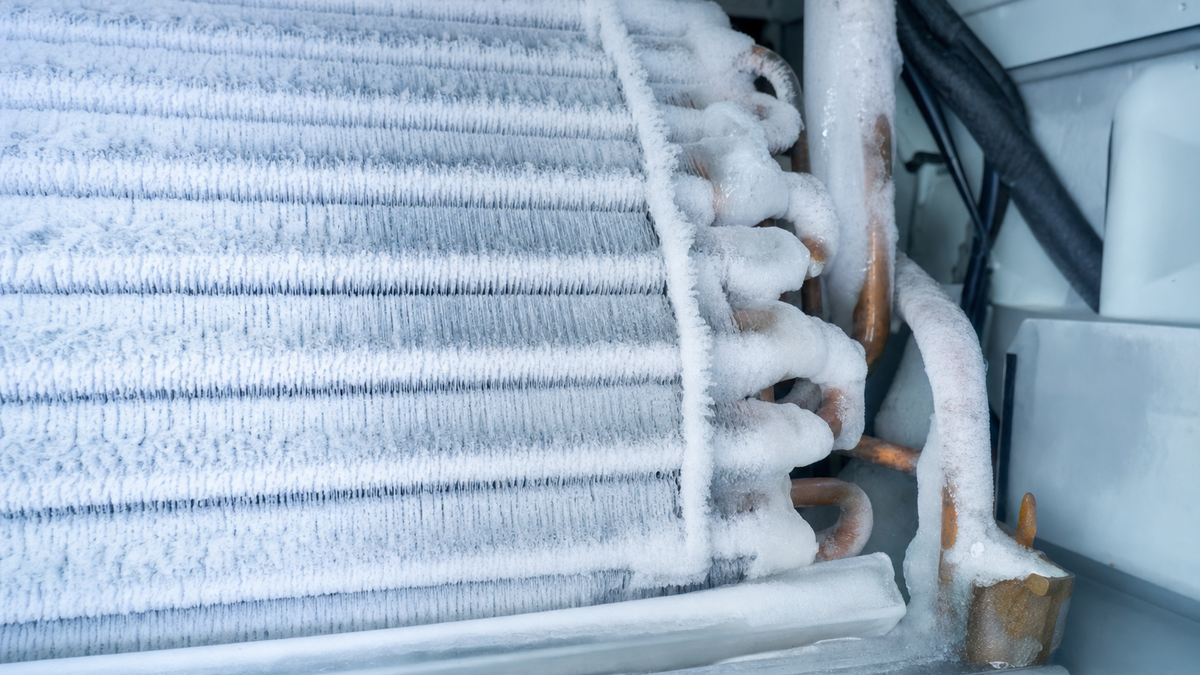
2. Ice or frost on the lines or indoor coil. This one surprises people. A refrigerant leak can actually make parts of your AC freeze over. When the charge drops, pressure in the evaporator coil falls, the coil temperature plunges below freezing, and humidity in the air condenses and freezes into a layer of ice. If you see frost on the larger copper line or a block of ice on the indoor unit, shut the system off before the ice damages the coil or floods your drain pan.
3. A hissing or bubbling sound. Refrigerant under pressure makes noise when it escapes. A small leak often produces a faint hiss, while a leak in the liquid line can sound like quiet bubbling or gurgling. If you hear either sound near the indoor air handler or the outdoor unit, that is a strong sign of an active refrigerant leak in your air conditioner.
4. Rising energy bills. A system that is low on refrigerant has to run far longer to cool your home, and that shows up on your power bill. If your usage habits have not changed but your electric bill keeps creeping up through the summer, a leak could be quietly draining your wallet.
5. Long or constant cooling cycles. With a proper charge, your AC cools the house, shuts off, and rests. When refrigerant runs low, the system can never quite reach the thermostat setting, so it runs almost continuously. Constant running wears out the compressor and the blower motor faster.
6. Higher humidity inside the home. Your AC does two jobs: it cools the air and it removes moisture. A low charge cripples both. If your St. Petersburg home suddenly feels clammy and sticky even when the thermostat reads a reasonable number, low refrigerant could be the reason.
7. Oily residue near fittings. Refrigerant travels with a small amount of lubricating oil. When gas escapes through a crack or a loose joint, it often leaves a greasy or oily film behind. Spotting that residue around a fitting, a coil, or the line set points right at the leak location.
Why Refrigerant Leaks Are Worse in Florida Heat
A refrigerant leak is a problem anywhere, but in Pinellas County it moves from inconvenient to serious fast. Our cooling season stretches across most of the year, so an AC system here logs far more runtime than the same unit would up north. That constant demand means a low charge gets exposed quickly, and the comfort hit is immediate when outdoor temperatures sit in the 90s with heavy humidity.
There is also the moisture factor. When your system is low on refrigerant, it loses much of its ability to dehumidify. In a dry climate that is mostly a comfort issue. In St. Petersburg, Clearwater, and Largo, where humidity routinely climbs above 70 percent, a system that can't pull water out of the air invites condensation, musty smells, and even mold growth on walls and around vents.
We have seen homeowners blame a humidity problem on their thermostat when the real culprit was a slow refrigerant leak starving the system.
The bigger risk is to the compressor. Refrigerant also carries the oil that lubricates the compressor, the most expensive single component in your AC. Running a system low on refrigerant for weeks can overheat and destroy that compressor, and once it goes, you are often looking at replacing the whole outdoor unit.
Many of the failures we describe in our article on AC compressor warning signs trace back to a system that ran low on charge for too long. Acting on the early symptoms of low freon in your AC is the single best way to avoid that outcome.
Hissing, ice, or warm air? We will find the leak and fix it right.
Killian's Air Conditioning - Licensed & Insured
📞 (727) 591-4776How to Tell a Refrigerant Leak From Other AC Problems
Here is the tricky part: the two most noticeable refrigerant leak signs, warm air and weak airflow, can also be caused by problems that have nothing to do with refrigerant. Before you assume the worst, it helps to rule out the simpler explanations. The table below lays out how the most common AC issues compare.
| Symptom | Refrigerant Leak | Dirty Air Filter | Failing Compressor | Blocked Condenser |
|---|---|---|---|---|
| Warm air from vents | Yes | Yes | Yes | Yes |
| Ice on indoor coil | Common | Common | Rare | Rare |
| Hissing or bubbling sound | Common | No | No | No |
| Loud humming or clicking outside | No | No | Common | Sometimes |
| Oily residue on lines | Yes | No | No | No |
| DIY fixable | No | Yes | No | Partly |
A few quick checks help you narrow it down at home. Start with the air filter, because a clogged filter chokes airflow and can mimic a refrigerant problem, ice and all. If the filter is gray and packed with dust, replace it and give the system a few hours to recover.
Next, walk outside and look at the condenser unit. If it is buried in grass clippings, leaves, or covered by a fence or shrubs, clear at least two feet of space around it so it can breathe.
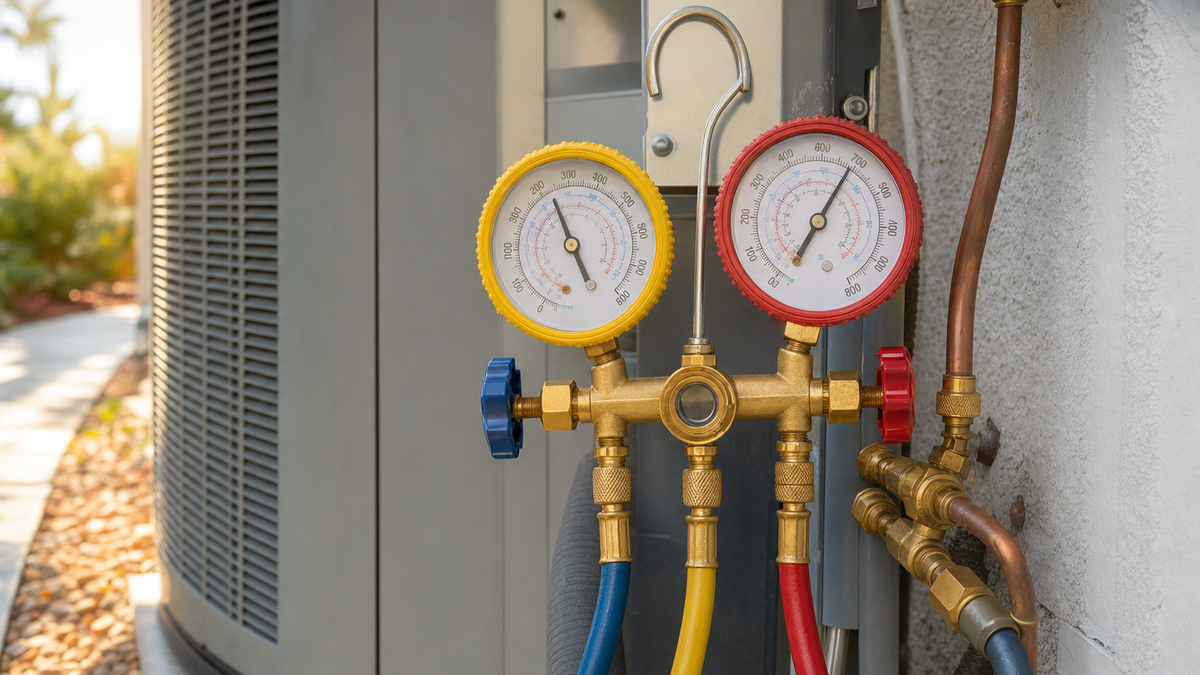
If the filter is clean, the outdoor unit is clear, and you are still getting warm air, ice, hissing, or that oily residue, the odds point strongly toward a refrigerant leak. At that point it is a job for a licensed technician, not a DIY fix. Refrigerant work requires specialized gauges, recovery equipment, and federal certification that homeowners simply do not have access to.
What Causes an AC Refrigerant Leak
Refrigerant leaks are not random. They come from a handful of predictable failure points, and a few of them are made worse by our coastal Florida environment. Knowing the common causes helps you understand why even a fairly new system can spring a leak.
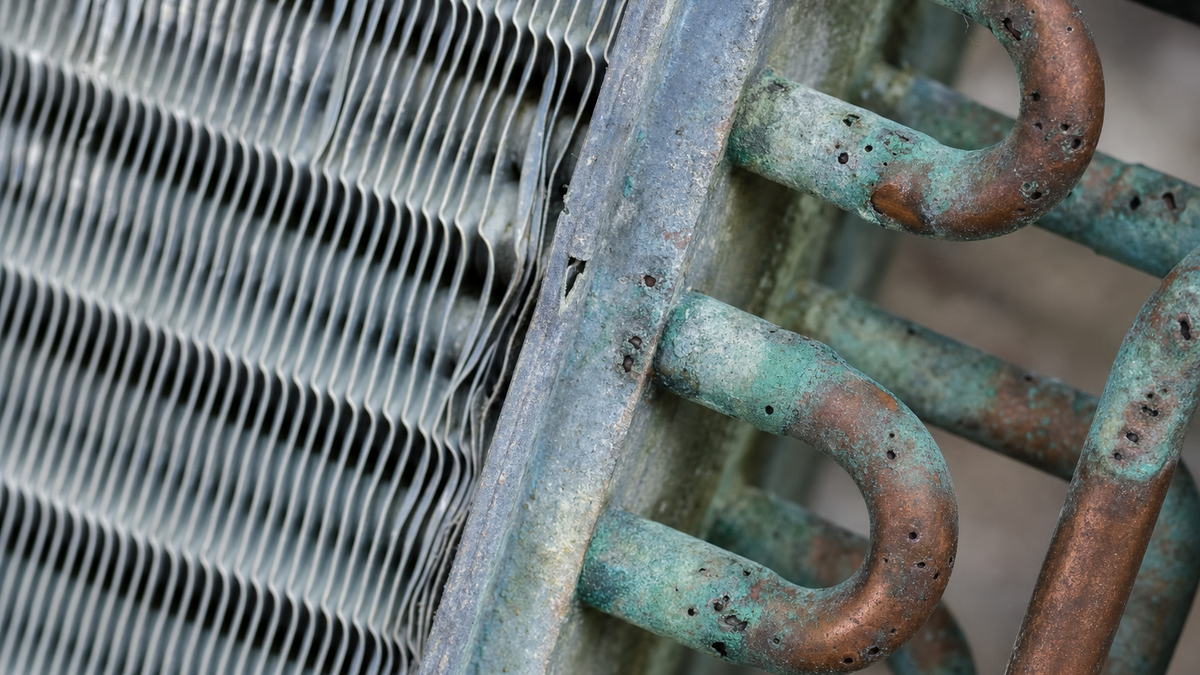
- Coil corrosion (formicary corrosion). Tiny pinholes form in the copper of the evaporator or condenser coil when the metal reacts with acids in the air. This is the leading cause of refrigerant leaks we find, and humid coastal air loaded with salt accelerates it. A coil can look fine to the eye while leaking through dozens of microscopic holes.
- Loose or worn flare fittings and joints. Years of vibration from normal operation can loosen the connection points where copper lines meet the equipment. A joint that was tight on installation day can weep refrigerant a few years later.
- Factory or installation defects. Occasionally a coil arrives with a weak braze joint or a manufacturing flaw, or a line set gets kinked during installation. These leaks often show up within the first year or two.
- Failing Schrader valves. The service valves technicians use to check pressure can develop slow leaks as their internal seals age, much like a leaky tire valve.
- Physical damage. A weed trimmer nicking the line set, a falling branch, or corrosion at the base of the outdoor unit can all puncture or crack the refrigerant lines.
In Pinellas County specifically, the combination of salt air, high humidity, and near year-round runtime means coil corrosion shows up sooner here than in drier inland climates. That is why we pay close attention to coil condition during every maintenance visit, which you can read more about in our overview of routine AC maintenance.
AC Refrigerant Leak Repair Cost and Why a DIY Fix Is Not Legal
AC refrigerant leak repair cost depends almost entirely on where the leak is and what it takes to reach it. A loose fitting near an accessible service valve is a quick repair. A pinhole in an evaporator coil buried inside the air handler often means replacing the entire coil. The table below gives typical ranges, but actual pricing varies by system, refrigerant type, and labor in your area, so treat these as ballpark figures only.
| Repair Scenario | Typical Cost Range | Notes |
|---|---|---|
| Electronic leak detection | $100 to $350 | Often credited toward the repair |
| Minor fitting or valve repair plus recharge | $200 to $700 | Best case, leak is accessible |
| Evaporator coil replacement | $1,000 to $2,800 | Common with formicary corrosion |
| Condenser or line set repair | $600 to $2,000 | Depends on location and access |
A word of caution on the refrigerant type. Systems using older R-22 refrigerant are expensive to recharge because R-22 has been phased out under federal rules and supplies are limited. If you have an older R-22 system with a significant leak, a recharge may cost enough that replacement starts to make financial sense. We break down that math in our guide on when to replace your AC unit.
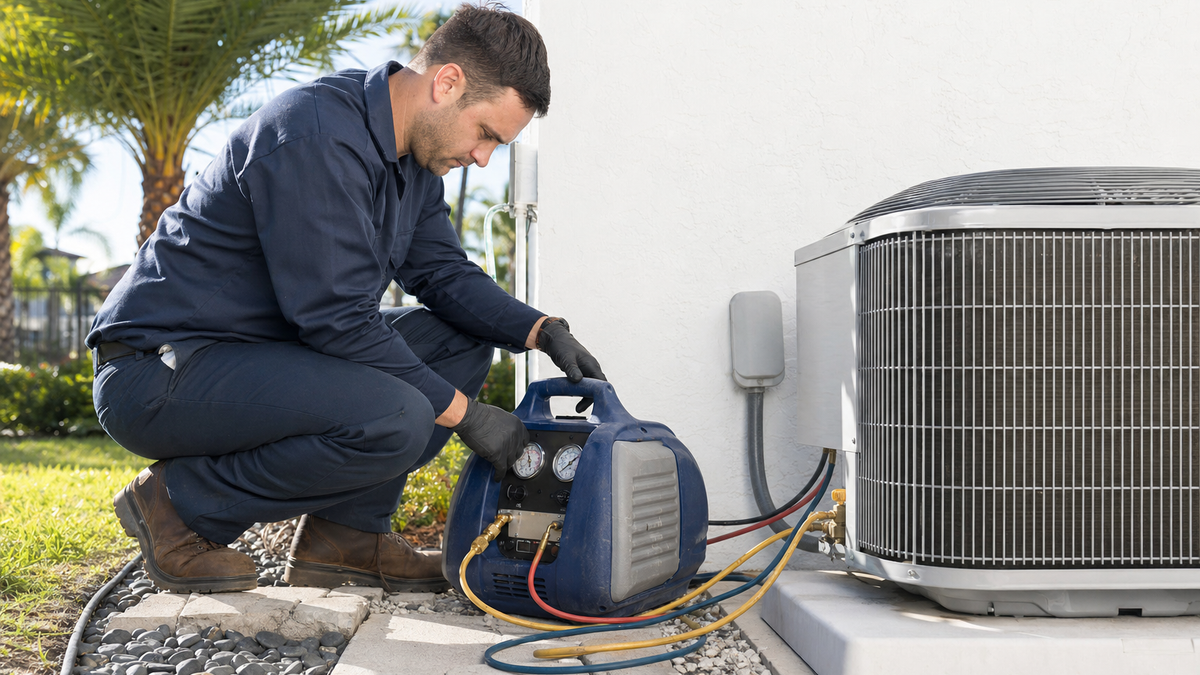
Here is the part many homeowners do not realize: you cannot legally fix this yourself. Under the EPA's Clean Air Act Section 608, only EPA-certified technicians are permitted to buy, handle, and charge refrigerant. Releasing refrigerant into the atmosphere, which is what happens when an untrained person opens a system, is illegal venting and carries real penalties.
The cans of "AC recharge" sold at auto parts stores are not appropriate for home HVAC systems, and using them masks the leak without fixing it. Topping off a leaking system is throwing money away, because the new refrigerant simply leaks out the same hole. The right approach is always to find the leak, repair it, and then recharge to the manufacturer's specified level.
What to Do If You Suspect a Refrigerant Leak
If the signs are pointing to a leak, a few smart moves protect your equipment and set you up for a faster, cheaper repair. Follow these steps in order.
- Switch the system to "off" or "fan" if you see ice. Running a frozen system can damage the coil and overwork the compressor. Turning it off lets the ice melt and prevents further harm while you arrange service.
- Do not add refrigerant yourself. Beyond being illegal without certification, a DIY recharge hides the symptom and can overcharge the system, which causes its own damage. Leave refrigerant handling to a certified pro.
- Check and replace the air filter. This rules out the simplest airflow problem. If a clean filter fixes the warm air, you may not have a leak at all.
- Clear the outdoor unit. Remove any debris, vegetation, or obstructions within two feet of the condenser so airflow is not part of the problem.
- Write down the symptoms. Note when the warm air started, whether you hear hissing, and where any ice or oily residue appears. This helps your technician find the leak faster.
- Call a licensed HVAC company for electronic leak detection. A pro will pinpoint the leak, repair it, evacuate the system, and recharge it to spec. If your home is uncomfortably hot, this may warrant same-day emergency AC service during our peak summer months.
Protect Your AC: When to Call Killian's Air Conditioning
If you have spotted any of these AC refrigerant leak signs, warm air, ice on the lines, a hissing sound, climbing energy bills, sticky indoor humidity, or oily residue around the fittings, do not wait for the problem to grow. A small leak caught early is an affordable repair. The same leak ignored through a Florida summer can cost you a compressor or the entire outdoor unit. Because refrigerant only drops when there is a leak, those symptoms will never fix themselves.
Our team is EPA certified and NATE certified, so we can legally and correctly detect the leak, repair it, and recharge your system to the manufacturer's specification. We serve homeowners across St. Petersburg, Clearwater, Largo, Seminole, and the surrounding Pinellas County communities with same-day service when you need it.
If your AC is showing the signs of low refrigerant, call Killian's Air Conditioning at (727) 591-4776. We are licensed in Florida under CAC1823158 and we are open 24/7 for emergencies, because in our climate a failing AC is never something that can wait.
Frequently Asked Questions
Can I still run my AC if it has a refrigerant leak?
You can run it for short periods, but it is not a good idea to keep running a system that is low on refrigerant. A low charge forces the compressor to work harder and run hotter, which shortens its life and can lead to a costly failure. If you see ice forming on the lines or indoor coil, switch the system off until a technician can inspect it, because running a frozen system causes real damage. The safest move is to schedule a repair quickly rather than nursing the unit along.
How long does AC refrigerant last if there is no leak?
In a properly sealed system, refrigerant lasts the entire life of the equipment, often 12 to 15 years or more. Refrigerant is not consumed or burned the way fuel is. It cycles endlessly between liquid and gas inside a closed loop, absorbing and releasing heat. This is exactly why a low refrigerant level always signals a leak. If a technician ever tells you the system just "needed a top off," ask them to find and fix the leak too, because the charge does not drop on its own.
Is a refrigerant leak dangerous to my health?
In the small amounts found in a home AC system, modern refrigerants are low in toxicity and rarely a health threat under normal conditions. The main risk comes with a large leak in an enclosed space, where refrigerant can displace oxygen. If you suspect a significant leak, ventilate the area, avoid open flames or sparks, and keep people and pets clear until a professional arrives. For ordinary slow leaks, the bigger concern is your equipment and your comfort, not immediate health danger.
How much does it cost to fix an AC refrigerant leak?
The cost varies widely depending on where the leak is. A minor fitting repair with a recharge typically runs from a few hundred dollars, while replacing a corroded evaporator coil can cost well over a thousand. Leak detection is usually a separate charge that is often credited toward the repair. Remember that a recharge alone is not a fix, since the refrigerant will leak right back out if the underlying leak is not repaired. A reputable company will quote the actual repair, not just a refill.
Why can't I just add refrigerant myself?
Federal law under EPA Section 608 restricts the purchase and handling of refrigerant to certified technicians. Venting refrigerant into the atmosphere, which is hard to avoid without proper equipment, is illegal and can carry fines. Beyond the legal issue, adding refrigerant without finding the leak only masks the problem temporarily, and overcharging the system causes its own damage. The store-bought recharge kits made for cars are not designed for home HVAC systems. Leak repair and recharging are genuinely jobs for a licensed pro.
How do technicians find a refrigerant leak?
Technicians use several methods, often in combination. An electronic leak detector sniffs out refrigerant in the air near fittings and coils. UV dye can be added to the system so the leak glows under a special light. A nitrogen pressure test pressurizes the system to reveal where it loses pressure, and a simple soap-bubble test highlights escaping gas at accessible joints. Pinpointing the exact leak location is what separates a lasting repair from a temporary recharge, which is why this step matters so much.