


Mini Split Installation St Petersburg: Pinellas Guide 2026
Mini Split Installation in St. Petersburg: A Pinellas County Homeowner's Guide
A mini split installation in St. Petersburg typically runs $3,000 to $5,500 for a single-zone system and $7,000 to $18,000 or more for a multi-zone setup, with most projects wrapping up in one to three days. For Pinellas County homes that need cooling in spaces a central system can't reach, ductless mini splits are usually the most efficient and least invasive option available.
This guide walks through where mini splits make sense (and where they don't), the install process from load calc to commissioning, real cost ranges in the St. Pete area, and what salt-air corrosion does to coastal equipment. If you've been quoted a mini split or you're trying to figure out whether one fits your home, this is the rundown.
| What You'll Learn | Where to Find It |
|---|---|
| What a ductless mini split actually is | Section 1 |
| Best Pinellas use cases (additions, garages, ADUs, older homes) | Section 2 |
| Single-zone vs multi-zone | Section 3 |
| Step-by-step install process | Section 4 |
| Real cost ranges in St. Petersburg | Section 5 |
| Coastal salt-air and lifespan | Section 6 |
| When NOT to pick a mini split | Section 8 |
What a Ductless Mini Split Is and How It Works
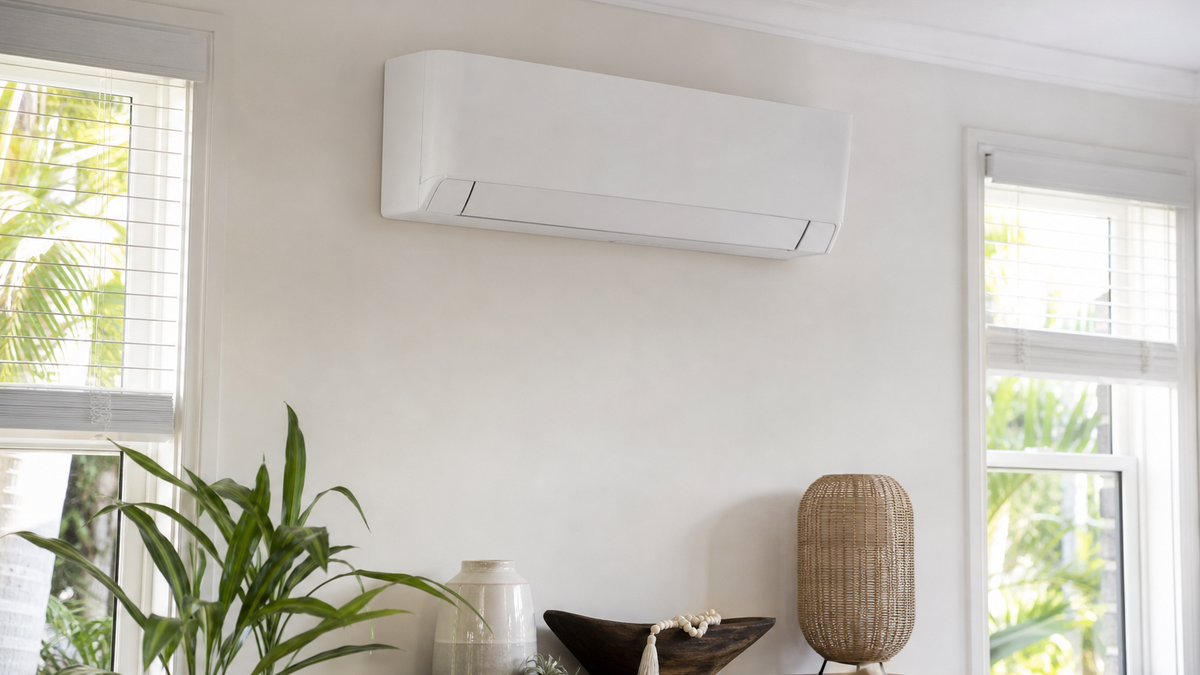
A ductless mini split is a heat pump system with two main parts: an outdoor compressor/condenser unit and one or more indoor air handlers (called "heads"). Instead of pushing conditioned air through a network of ducts, refrigerant runs directly to each indoor head through a small line set, usually about 3 inches in diameter, that passes through the wall.
The indoor heads come in a few styles. Wall-mounted heads are the most common and the most affordable. Ceiling cassettes sit flush in the ceiling and look almost like a recessed light fixture. Floor consoles sit at baseboard level for rooms where wall and ceiling space is limited. Each head has its own remote or wall thermostat, so you control each room independently.
What sets mini splits apart from standard central AC is the inverter-driven variable-speed compressor. A traditional central AC compressor runs at full blast or shuts off entirely. An inverter compressor ramps up and down smoothly, holding your set temperature with much less cycling. In Florida's partial-load climate, where you rarely need maximum cooling but you almost always need some cooling, that translates to better humidity removal and lower energy bills.
For Pinellas County homeowners, the humidity advantage matters as much as the cooling. Mini splits run longer at lower speeds, which gives the indoor coil more time to pull moisture out of the air. That's a meaningful difference if you live in a beach cottage on Treasure Island or a Florida room that always feels sticky.
Best Use Cases for Mini Split Installation in St. Petersburg Homes

Not every home needs a mini split, but a few situations come up over and over again in Pinellas County where ductless is clearly the right call. Here are the use cases we see most often when quoting a mini split installation in St. Petersburg.
- Detached garages, workshops, and ADUs that have no duct runs
- Room additions that the original central system was never sized to cool
- Sunrooms and Florida rooms with single-pane glass and high heat load
- Older block homes (Old Northeast, Historic Kenwood, Gulfport) with no existing ductwork
- Beach cottages on Pass-a-Grille, Treasure Island, and Madeira Beach with chronic humidity
- Second-story bonus rooms where the central system can't keep up
- Home offices that need different temperatures than the rest of the house
Garages, Workshops, and ADUs
A converted garage in St. Pete can hit 110+ degrees in July with the door closed. Running new ductwork from the main air handler is rarely practical, especially if the garage is detached or has been converted into a gym, workshop, or accessory dwelling unit. A single-zone 12,000 to 18,000 BTU mini split handles most one-car garages comfortably and gives you a dedicated thermostat for the space.
Detached ADUs and mother-in-law suites work the same way. One outdoor unit, one indoor head, one electrical disconnect, and you've got a fully conditioned space without touching the main home's HVAC system.
Room Additions, Sunrooms, and Florida Rooms
If you added 200 to 500 square feet to your home, your existing central AC was almost certainly sized for the original footprint. Trying to push an undersized system to cool the addition stresses the compressor and leaves the new room hot and humid.
Adding a single-zone mini split is usually cheaper than upsizing the central system, especially when you factor in new ductwork, a new air handler, and the cost of cutting into walls to extend supply runs. Sunrooms are an even better candidate because they tend to have heavy solar gain through large windows that throws off the heat load calculations on a central system.
Older Pinellas Homes Without Ductwork
A lot of pre-1965 block homes in Old Northeast, Historic Kenwood, and Gulfport never had central ductwork installed. Many still rely on window units or outdated package systems. Retrofitting these homes with traditional ducted central AC means tearing into ceilings, soffits, and closets to make room for trunk lines and supply runs. That kind of construction adds $5,000 to $15,000 on top of the equipment itself.
A multi-zone mini split with three to five indoor heads accomplishes whole-home conditioning without that demolition. Each head only needs a 3-inch hole in an exterior wall and a small electrical run. For historic homes where preserving the interior matters, ductless is often the only sensible path forward.
Single Zone vs Multi Zone Mini Split: Which You Need
The single biggest decision in a mini split project is how many zones (indoor heads) you need. A single-zone setup uses one outdoor unit paired with one indoor head, and a multi-zone setup connects one outdoor unit to two through eight indoor heads, each with its own thermostat.
| Feature | Single-Zone Mini Split | Multi-Zone Mini Split |
|---|---|---|
| Outdoor units | 1 | 1 |
| Indoor heads | 1 | 2-8 (varies by model) |
| Capacity range | 9,000-36,000 BTU | 18,000-60,000+ BTU total |
| Typical installed cost (Pinellas) | $3,000-$5,500 | $7,000-$18,000+ |
| Install time | 1 day (4-8 hrs) | 2-3 days |
| Best for | Single room, garage, ADU, addition | Whole-home, multi-room retrofit |
| Independent room control | One zone only | Yes, per indoor head |
Pick single-zone when: you only need to condition one space (a garage, a converted attic, one stubborn bedroom). Single-zone is cheaper, simpler, and the equipment options are wider.
Pick multi-zone when: you're conditioning multiple rooms or a whole home without ducts. Multi-zone shares one outdoor footprint, which matters on smaller St. Pete lots where you don't want three separate condensers cluttering the side of the house. The trade-off is that if the outdoor compressor fails, every indoor head goes down at once.
A practical middle path we see often: pair a single-zone mini split with the existing central system. The central handles the main living areas through ducts, and the mini split picks up the addition or garage that the central can't reach. You get whole-home comfort without committing to a full multi-zone retrofit.
The Mini Split Installation Process Step by Step

A typical mini split installation in St. Petersburg follows a predictable sequence. Knowing the steps helps you spot a contractor cutting corners before it costs you down the road. Here's what a clean install looks like from arrival to commissioning.
- Manual J load calculation. Before any equipment gets ordered, the contractor measures square footage, ceiling heights, window orientations, insulation levels, and number of occupants for each room being conditioned. This determines BTU capacity per zone. Sizing by square footage alone almost always produces an oversized unit, which short-cycles and never pulls humidity out properly.
- Indoor head placement. The head goes high on a wall (typically 6 to 7 feet up) on an exterior wall when possible, so the line set has the shortest path to the outdoor unit. The location also matters for airflow patterns and aesthetics.
- Outdoor unit placement. The condenser sits on a level concrete pad at ground level or on a wall-mounted bracket. In Pinellas County, we set pads above the FEMA flood elevation when possible and use hurricane-rated tie-down straps. Maintain at least 12 inches of clearance around the unit and 60 inches above for service access.
- Wall penetration and line set. A 3-inch hole gets drilled through the exterior wall, sloping slightly downward toward the outside to keep condensate from backflowing. The refrigerant line set, condensate drain, and control wiring all bundle together and run through the penetration.
- Electrical work. Mini splits need a dedicated 240V circuit (most models) with a properly sized breaker and a service disconnect within sight of the outdoor unit. If your panel is full or undersized, this step adds time and cost.
- Vacuum and pressure test. The line set must be evacuated to a deep vacuum (around 500 microns) and held to confirm there are no leaks. This step gets skipped by sloppy installers and is the single most common cause of premature compressor failure.
- Refrigerant charge and commissioning. Most modern mini splits come pre-charged for line sets up to 25 feet. Longer runs require additional refrigerant. The tech then runs the system, verifies superheat and subcooling, confirms airflow at each head, and walks you through the remote and the app.
Single-zone installs typically wrap in one day (4 to 8 hours). Multi-zone projects with 3 or 4 heads run 2 to 3 days, especially if any electrical panel work is involved. For more on what to verify during any AC project, see our full AC installation checklist.
Thinking about a mini split for your St. Pete home? Get a no-pressure quote.
Killian's Air Conditioning - Licensed (CAC1823158) & Insured
Call (727) 591-4776Mini Split Installation Cost in St. Petersburg and Pinellas County
Real-world pricing for a mini split installation in St. Petersburg depends on the number of zones, the brand, the line set length, and any electrical upgrades the panel needs. Here are the ranges we see most often across Pinellas County in 2026.
| Configuration | Typical Installed Cost | Notes |
|---|---|---|
| Single-zone, 9,000-12,000 BTU | $3,000-$4,500 | Garage, small addition, one bedroom |
| Single-zone, 18,000-24,000 BTU | $4,000-$5,500 | Larger addition, master suite, finished attic |
| 2-zone multi-zone | $7,000-$10,500 | 2 indoor heads, shared outdoor unit |
| 3-zone multi-zone | $10,000-$14,000 | Whole-home retrofit, 3 heads |
| 4-zone or larger multi-zone | $14,000-$18,000+ | Full ductless conversion |
What pushes cost up in Pinellas County:
- Line set runs over 25 feet add labor and refrigerant cost (most equipment is pre-charged for 25 feet)
- Second-story head placement requires longer line runs and more cutting
- Electrical panel upgrades if the existing panel is full or under-amperage
- Coastal corrosion-resistant equipment (BlueFin or coated coils) typically adds $300-$800 per indoor head
- Mechanical permit and inspection in Pinellas County, usually $75-$200 depending on jurisdiction
- Ceiling cassette or floor console heads cost more than basic wall-mounted heads
Brand pricing tiers in our market generally break down like this. Mid-tier brands such as MrCool and Pioneer come in cheapest. Major brands like LG and Fujitsu sit in the middle. Mitsubishi Electric and Daikin are the premium tier and typically carry a 5 to 12-year parts warranty plus long-track records in coastal applications.
Federal tax credits under the Inflation Reduction Act may apply to qualifying high-efficiency heat pump installations, including many mini splits. Check the manufacturer's CEE tier listing and consult a tax professional for your specific situation.
Salt Air, Humidity, and Lifespan on Pinellas Coastal Installs
If you live within a mile or two of the Gulf, salt-air corrosion is the single biggest threat to your mini split's lifespan. Salt accelerates oxidation on the aluminum fins of the outdoor coil, eats at copper line sets, and can chew through circuit boards on lower-end equipment.
We've serviced beach cottages on Pass-a-Grille and Treasure Island where uncoated outdoor units failed in 6 to 8 years, while a similar coated unit a few blocks away was still running fine at year 12. The difference is almost entirely about coil protection and rinse maintenance.
| Location | Typical Lifespan (with maintenance) | Key Recommendation |
|---|---|---|
| Inland Pinellas (5+ miles from Gulf) | 12-15 years | Standard equipment is fine |
| Mid-county (1-5 miles from coast) | 10-13 years | Coated coils strongly recommended |
| Beach properties (under 1 mile) | 8-12 years | Coastal kit + quarterly fresh-water rinse |
Coastal protection options to ask for:
- Mitsubishi BlueFin anti-corrosion coil coating (factory-applied)
- Daikin coastal kit with coated coils and stainless hardware
- Field-applied coil coatings (less effective than factory-applied but better than nothing)
- Wall-mounted brackets that keep the outdoor unit elevated and away from sand
- Annual or quarterly fresh-water coil rinses during the dry season
The humidity advantage of mini splits actually plays in your favor on the coast. Beach cottages often run sticky because window units and undersized central systems can't keep up with the moisture load. A properly sized mini split with a variable-speed compressor pulls humidity out continuously, which beats both the comfort and the mold-prevention game in coastal homes.
Mini Split vs Central AC: Energy Efficiency in Florida

Modern mini splits commonly carry SEER2 ratings of 20 to 30, while standard central AC systems typically come in at 14 to 18 SEER2. The federal minimum for southern states (including Florida) is currently 14.3 SEER2 for split-system central AC.
Three things drive the efficiency gap:
- Inverter compressors ramp speed up and down rather than cycling on and off, which avoids the energy spike of restarts and matches output to actual demand.
- No duct losses. Central systems lose 20 to 30% of their conditioned air through duct leaks, especially in Florida attics that hit 140+ degrees. Ductless skips that loss entirely.
- Zone-level control means you only condition the rooms you're using. Empty bedrooms during the workday don't get cooled.
In Pinellas County, where AC runs 8 to 10 months per year, those efficiency gains compound. The energy savings from a 22 SEER2 mini split versus a 14 SEER2 central system can run several hundred dollars per year in the spaces it conditions.
The catch is that a single mini split head won't replace a whole central system. If you're conditioning a 2,400 square foot home, you'll need 3 or 4 indoor heads to match the coverage, which is why the multi-zone cost climbs into the $14,000+ range. For homes where central ducts are already in place and in good condition, adding a zoned HVAC system with motorized dampers often delivers similar room-by-room control at lower upfront cost.
When NOT to Pick a Mini Split
Mini splits are not the right answer for every home. Here's when we tell St. Pete homeowners to skip ductless and go a different direction.
Your existing central system and ductwork are in good shape. If your ducts are sealed, sized correctly, and less than 15 years old, a high-efficiency central AC replacement is almost always cheaper for whole-home conversion than a multi-zone mini split. You already paid for the duct infrastructure, so use it.
You hate the look of indoor heads on the wall. Wall-mounted heads are visible, full stop. Ceiling cassettes blend in better but cost more. If interior aesthetics are a hard line for you, a concealed-duct mini split or a traditional ducted system is the better path.
You have a very large open-concept space. A single indoor head has a limited throw range, typically 15 to 25 feet of effective coverage. A 1,000 square foot great room with a vaulted ceiling needs either two heads or a ducted air handler to feel even.
Your HOA or condo association restricts exterior modifications. Many Pinellas condo communities, including some in Snell Isle, Pasadena, and parts of downtown St. Pete, have rules against exterior wall penetrations, visible condensers on balconies, or refrigerant line covers on building facades. Check your HOA documents before you sign a contract.
Your central system is on its last legs and your budget is tight. If you're already facing a central replacement and money is the constraint, replace the central first and add a mini split later if you still need supplemental cooling. Splitting your budget across two projects often means neither one gets done right.
Frequently Asked Questions About Mini Split Installation
How long does a mini split installation take in St. Petersburg?
A single-zone mini split installation typically takes 4 to 8 hours, so most homeowners are back to normal by the end of the day. Multi-zone systems with 3 or 4 indoor heads run 2 to 3 days because each indoor head requires its own line set, wall penetration, and commissioning. Add a half-day if your electrical panel needs an upgrade or if the line set has to run more than 25 feet to reach the outdoor unit. We schedule installs to wrap before sunset whenever possible so the system runs overnight after commissioning.
Do I need a permit for mini split installation in Pinellas County?
Yes. Pinellas County and the City of St. Petersburg both require a mechanical permit for any new air conditioning installation, including ductless mini splits. The licensed HVAC contractor pulls the permit, schedules the inspection, and is responsible for code compliance. Permit fees usually run $75 to $200 depending on jurisdiction. Never hire a contractor who suggests skipping the permit, because unpermitted work can void your equipment warranty, complicate a future home sale, and leave you on the hook for code violations.
How much does a mini split cost installed in Florida?
A single-zone mini split runs $3,000 to $5,500 installed in St. Petersburg, depending on capacity, brand, and line set length. Multi-zone systems start around $7,000 for a 2-zone setup and climb to $18,000 or more for a 4-zone whole-home install. Coastal corrosion-resistant equipment adds roughly $300 to $800 per indoor head. Premium brands like Mitsubishi and Daikin sit at the high end of these ranges but include longer warranties and better long-term reliability in coastal climates.
Can a mini split heat my Florida home in winter?
Yes. Mini splits are heat pumps by design, so the same equipment that cools your home in summer flips into heating mode in winter. Pinellas County winter lows rarely drop below 40 degrees, which is well within the comfortable operating range of any modern mini split. Many models continue producing heat efficiently down to 5 degrees Fahrenheit or lower. For most St. Pete homeowners, the heating capability is a bonus rather than a primary need, but it does eliminate the cost of a separate furnace or strip heater.
How long do mini splits last in coastal Florida?
Inland Pinellas County installations typically last 12 to 15 years with normal maintenance. Within 1 mile of the Gulf, expect 8 to 12 years for standard equipment because salt air accelerates corrosion on the outdoor coil. Models with factory-applied anti-corrosion coatings (Mitsubishi BlueFin, Daikin coastal kits) plus annual or quarterly fresh-water coil rinses can stretch coastal lifespans to 12 years or more. The single best thing you can do for a coastal mini split is rinse the outdoor coil with a garden hose at low pressure several times a year.
Are mini splits noisy?
Mini split indoor heads are notably quiet, running between 19 and 32 decibels on low fan speed, which is quieter than a whisper or a library. Outdoor condensers operate around 50 to 60 decibels at the unit, similar to a refrigerator hum or normal conversation. Both are significantly quieter than window units or older central air handlers. If you place the outdoor unit on a side wall facing a fence rather than directly outside a bedroom window, you'll rarely notice it running.
Get a Mini Split Installation Quote for Your St. Petersburg Home
A mini split installation is a 12 to 15 year investment in comfort, and the right project starts with an honest evaluation of whether ductless even fits your home. Here's the quick recap before you make the call.
Key takeaways:
- Mini splits shine for additions, garages, sunrooms, ADUs, beach cottages, and older homes without ductwork.
- Single-zone systems run $3,000 to $5,500 installed; multi-zone runs $7,000 to $18,000+ depending on indoor head count.
- Coastal St. Pete homes need corrosion-resistant equipment and regular coil rinsing to hit 12-plus year lifespans.
- Mini splits commonly hit 20 to 30 SEER2 and beat central AC efficiency in Florida's partial-load climate.
- If your existing central system and ductwork are in good shape, a zoned HVAC system often beats ductless on cost.
Killian's Air Conditioning installs ductless mini splits across St. Petersburg, Clearwater, Largo, Seminole, Dunedin, Palm Harbor, Tarpon Springs, Gulfport, and the rest of Pinellas County. Every quote includes a Manual J load calculation, full permitting through the local jurisdiction, coastal corrosion considerations for beach properties, and a post-install walkthrough so you know how to use the system.
Call (727) 591-4776 or visit our ductless mini split service page to schedule a free in-home estimate. Licensed FL HVAC contractor #CAC1823158, EPA certified, NATE certified, and family-owned right here in St. Pete.
Life's a Breeze with Killian's Air.