
AC Installation Checklist: 10 Steps Before, During, After
A new air conditioning installation is one of the biggest investments you'll make in your home, typically running $4,500 to $12,000 or more in the St. Petersburg area. The difference between a system that runs efficiently for 15+ years and one that causes problems from day one often comes down to what happens before the installer shows up, what you verify while they're working, and what you check after they leave.
This checklist breaks the entire ac installation process into three phases: before, during, and after. Each item includes what to look for, why it matters, and when to push back if something seems off. Print it, save it, or pull it up on your phone on installation day.
| Phase | Checklist Items | Key Focus |
|---|---|---|
| Before (4 items) | Load calculation, contractor vetting, permits, proposal review | Getting the right system and crew |
| During (3 items) | Refrigerant lines, electrical, ductwork sealing | Quality control on install day |
| After (3 items) | Temperature split test, thermostat setup, permit inspection | Confirming everything works |
Before Your Air Conditioning Installation: 4 Steps to Get Right First

The decisions you make before your air conditioning installation determine 80% of your long-term satisfaction. These four checklist items protect you from oversized equipment, unlicensed contractors, and surprise costs.
- Manual J load calculation completed
- Contractor license, insurance, and permit verified
- Written proposal reviewed with equipment specs
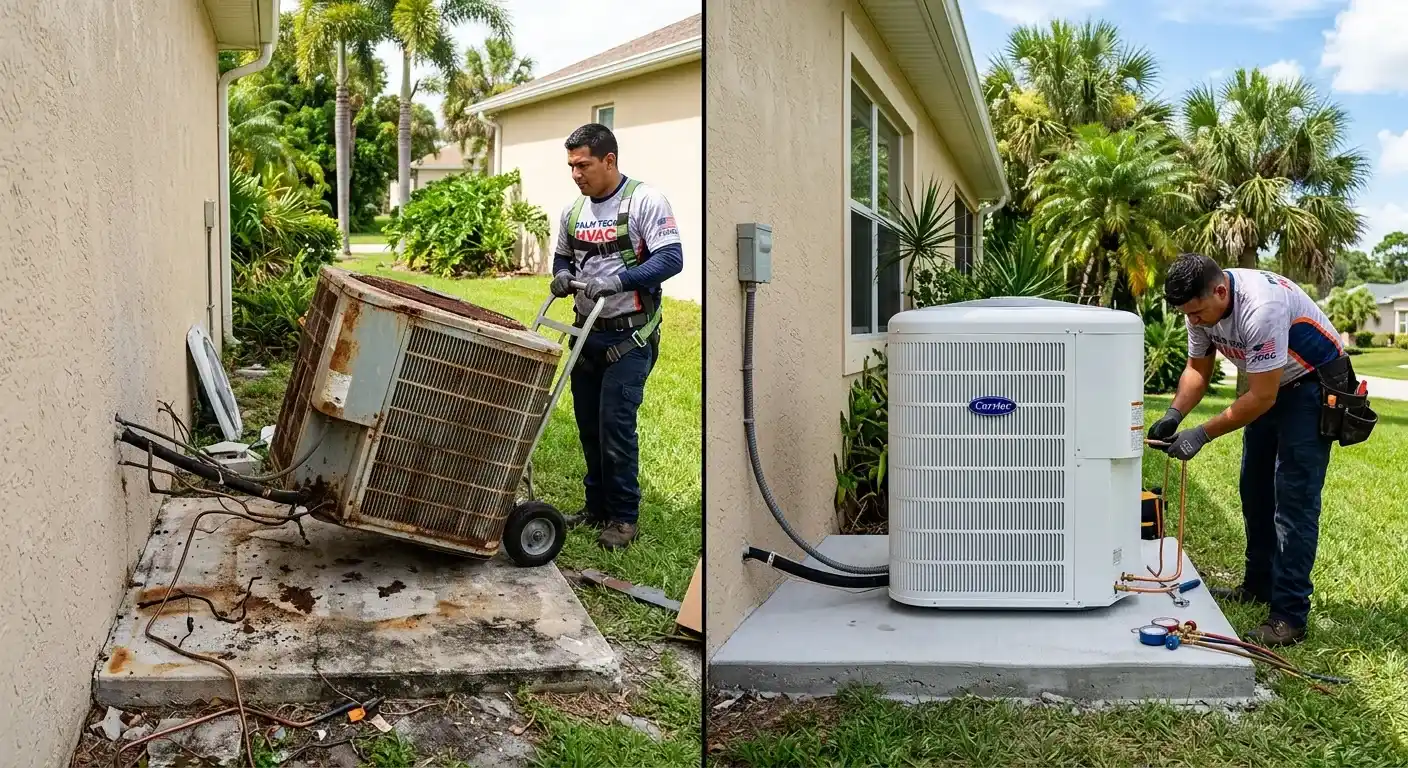
- Old system disposal plan confirmed
Confirm a Manual J Load Calculation Was Performed
A Manual J load calculation is a room-by-room analysis of how much cooling your home actually needs. It factors in square footage, insulation levels, window orientation, ceiling height, and local climate data.
Why this matters in Florida: Humidity is half the battle. An oversized AC cools the air quickly but shuts off before removing enough moisture, leaving your home clammy and promoting mold growth. An undersized unit runs constantly without reaching your set temperature, driving up energy bills and wearing out faster.
In Pinellas County, many older homes were built with minimal insulation. A 1,500-square-foot block home in St. Petersburg may need a very different system than a 1,500-square-foot newer build in Palm Harbor. Guessing based on square footage alone is how homeowners end up with the wrong size.
Red flag: If a contractor quotes you a system size without visiting your home or performing calculations, find a different contractor.
Verify Contractor Licensing, Insurance, and Permits
Florida law requires any company installing air conditioning to hold an active CAC (Class A Air Conditioning) or CMC (Class C Mechanical) license. You can verify any contractor's license on the Florida DBPR website.
Your ac installation checklist for vetting contractors:
- Active Florida CAC or CMC license number (ask for it upfront)
- General liability insurance and workers' compensation coverage
- Written confirmation they will pull the building permit
- References from recent installations in your area
Pinellas County requires a building permit for any new ac unit installation. The contractor should pull this permit, not you. If a contractor suggests skipping the permit to save money or time, walk away. An unpermitted installation can void your warranty, create problems when selling your home, and leave you liable if something goes wrong.
Review the Written Proposal and Equipment Specs
Before signing anything, your proposal should include every detail in writing. Verbal promises mean nothing if there's a dispute later.
What a complete proposal includes:
| Item | Why It Matters |
|---|---|
| Equipment brand and model numbers | Confirms you're getting what you're paying for |
| SEER2 efficiency rating | Determines long-term energy costs |
| Warranty terms (parts, labor, compressor) | Protects your investment for 5-10 years |
| Total installed cost, itemized | Prevents hidden charges on installation day |
| Estimated completion timeline | Sets expectations for the work |
| Disposal of old equipment | Confirms who removes and recycles the old unit |
| Thermostat included or upgraded | Avoids surprise charges for a new thermostat |
If the proposal just says "3-ton AC system" without a model number, SEER2 rating, or warranty breakdown, ask for specifics before signing.
Planning a new AC installation? Get a detailed quote with no hidden fees.
Killian's Air Conditioning - Licensed (CAC1823158) & Insured
Call (727) 591-4776AC Installation Cost: What to Expect in Pinellas County
The total cost of air conditioning installation in the Tampa Bay area depends on system type, home size, ductwork condition, and efficiency rating. Here are typical ranges based on what Pinellas County homeowners can expect:
| System Type | Typical Cost (Installed) | Best For |
|---|---|---|
| Standard central AC (14-15 SEER2) | $4,500 - $7,500 | Budget-friendly replacement |
| High-efficiency central AC (16-20 SEER2) | $6,500 - $10,000 | Long-term energy savings |
| Heat pump system | $5,500 - $9,500 | Homes needing heating and cooling |
| Ductless mini-split (single zone) | $3,000 - $5,500 | Room additions, garages, sunrooms |
| Full system with ductwork replacement | $8,000 - $15,000+ | Older homes with deteriorated ducts |
Factors that push costs higher in Florida:
- Attic installations requiring additional labor in extreme heat
- Homes needing electrical panel upgrades to support a new system
- Ductwork modifications or complete replacement
- Code-required upgrades (hurricane straps, updated disconnects)
- High-efficiency systems with variable-speed compressors
AC installation cost tip: A higher SEER2 unit costs more upfront but saves money over time. In Florida, where your AC runs 8-10 months per year, the energy savings from a 16 SEER2 unit versus a 14 SEER2 unit can add up to $200-$400 annually. Over a 15-year system lifespan, that's $3,000-$6,000 in savings.
During Installation Day: 3 Things to Watch For

A standard AC installation takes 4-8 hours for most homes. During that time, you don't need to hover over the crew, but checking a few critical items protects you from common installation shortcuts.
- Refrigerant lines properly brazed and insulated
- Electrical connections meet code with proper disconnect
- Ductwork modifications sealed with mastic (not duct tape)
Confirm Proper Refrigerant Line and Electrical Work
The copper refrigerant lines connecting your indoor and outdoor units need to be brazed (welded), not just flared, for a permanent, leak-free connection. Brazing uses a torch to fuse the copper, creating a stronger joint than mechanical flare fittings.
Both the suction line (the larger, insulated line) and the liquid line should be properly insulated. In Florida's heat, uninsulated lines lose efficiency and can develop condensation that leads to water damage in your attic or walls.
Electrical checklist for installation day:
- New disconnect box installed near the outdoor unit
- Proper wire gauge for the system's amperage requirements
- Breaker in the electrical panel matches the manufacturer's specs
- Surge protector installed (Florida's lightning makes this essential)
Florida leads the nation in lightning strikes. A whole-home or dedicated HVAC surge protector costs $75-$200 installed and can save you from a $1,500+ control board replacement after a summer storm.
Check That Ductwork Modifications Are Sealed Correctly
If your new system connects to existing ductwork, every joint and connection should be sealed with mastic sealant or UL 181-rated aluminum foil tape. Standard duct tape fails within 1-2 years in Florida attic temperatures, which regularly exceed 140 degrees in summer.
What to look for:
- All duct connections have visible mastic or foil tape at the seams
- No gaps where you can see light or feel air escaping
- Flex duct runs are supported properly (not kinked or sagging)
- Supply and return boots are sealed where they meet the drywall
Leaky ductwork after a new installation is one of the most common complaints we see in Clearwater and Largo homes. A new high-efficiency system connected to leaky ducts can waste 20-30% of its cooling capacity before the air even reaches your rooms.
After the AC Installation: 3 Post-Install Checks
Once the crew finishes and your new system is running, these three checks confirm the installation was done correctly.
- Temperature split reads 15-20 degrees between supply and return
- Thermostat programmed correctly for your schedule
- Building permit inspection scheduled within 30 days
Test the Temperature Split Across the Supply and Return
This is the simplest way to verify your new system is performing correctly. Place a thermometer at a supply vent (where cold air blows out) and another at the return vent (where air gets pulled in).
The temperature difference should be 15-20 degrees. For example, if return air reads 78 degrees, supply air should read 58-63 degrees.
| Temperature Split | What It Means |
|---|---|
| 15-20 degrees | Normal, system is working correctly |
| Less than 15 degrees | Possible low refrigerant, airflow restriction, or sizing issue |
| More than 20 degrees | Possible airflow restriction (dirty filter, closed vents, ductwork problem) |
Run this test after the system has been operating for at least 15-20 minutes. If the split is outside the normal range, contact your installer before signing off on the job.
Confirm the Building Permit Inspection Was Scheduled
In Pinellas County, the building permit inspection verifies that the installation meets Florida Mechanical Code and local requirements. Your contractor is responsible for scheduling this inspection, but you should confirm it's been done.
Why the inspection matters:
- Validates the installation meets safety and code requirements
- Protects your manufacturer warranty (some require permitted installation)
- Prevents issues if you sell your home (unpermitted work flags on title searches)
- Ensures proper thermostat settings and system configuration
Ask your contractor for the permit number and expected inspection date before they leave. Most Pinellas County inspections happen within 1-2 weeks of the completed installation.
When to Call a Professional After Your New AC Installation

New systems can behave slightly differently than your old one, and not every change is a problem. Here's what's normal versus what requires a callback.
Normal in the first week:
- Slight plastic or chemical smell (new components off-gassing, fades in 1-3 days)
- The system cycles differently than your old unit (variable-speed systems ramp up and down)
- Slightly different airflow sounds at the vents
Call your installer if you notice:
- Water leaking from the indoor unit or drain pan
- Unusual grinding, squealing, or banging noises from either unit
- The system runs constantly without reaching the set temperature
- Ice forming on the refrigerant lines or indoor coil
- A burning or acrid electrical smell (turn the system off immediately)
- Circuit breaker tripping repeatedly
Warranty activation reminder: Most manufacturers require you to register your new equipment within 60-90 days of installation for full warranty coverage. Your installer may handle this, but confirm it. Unregistered systems typically default to a shorter 5-year parts warranty instead of the full 10-year coverage.
Complete AC Installation Checklist: Printable Summary
Use this consolidated ac installation checklist as your quick reference before, during, and after your air conditioning installation.
Before Installation:
- Manual J load calculation performed (not just square footage estimate)
- Contractor's Florida CAC/CMC license verified on DBPR website
- Proof of insurance and workers' comp obtained
- Building permit confirmed (contractor pulls it, not you)
- Written proposal includes: model numbers, SEER2 rating, warranty terms, itemized cost
- Old equipment disposal plan agreed upon
During Installation:
- Refrigerant lines brazed (not just flared) and both lines insulated
- Electrical disconnect installed, wire gauge matches specs
- Surge protector installed for lightning protection
- All ductwork connections sealed with mastic or UL 181-rated tape
- Condensate drain line properly routed with P-trap
- Outdoor unit placed on level pad with proper clearance (24+ inches on all sides)
After Installation:
- Temperature split test: 15-20 degrees between supply and return
- Thermostat programmed for your daily schedule
- Contractor provided permit number and scheduled inspection
- Warranty registration completed with manufacturer (within 60-90 days)
- First maintenance visit scheduled for 6 months after installation
- All documentation saved: proposal, warranty cards, permit, user manuals
FAQ
How long does a new AC installation take?
A standard replacement takes 4-8 hours for most homes. The crew will disconnect and remove the old system, install the new indoor and outdoor units, connect refrigerant lines and electrical, and test the system. If your installation involves ductwork modifications, electrical panel upgrades, or moving the air handler location, expect 1-2 full days. Multi-zone or ductless systems with several indoor heads can also extend the timeline. Your contractor should give you a specific time estimate in the written proposal.
What SEER2 rating should I choose for a new AC in Florida?
For Florida homes, aim for at least 15-16 SEER2. The federal minimum for southern states is currently 14.3 SEER2 (as of 2023), so any new ac installation will meet at least that threshold. Since Florida ACs run 8-10 months per year, the energy savings from a higher-efficiency unit add up faster here than in cooler climates.
A 16 SEER2 system typically saves $200-$400 per year in electricity compared to a 14 SEER2 unit. Systems rated 18-20+ SEER2 offer the best efficiency but come with a price premium that may take 8-12 years to recoup.
Do I need a permit for AC installation in Pinellas County?
Yes, a building permit is required for AC installation in Pinellas County and throughout Florida. Your HVAC contractor is responsible for pulling the permit and scheduling the post-installation inspection. The permit fee is typically $75-$200 depending on the scope of work. Never hire a contractor who suggests skipping the permit. An unpermitted installation can void your equipment warranty, create complications if you sell your home, and leave you responsible for any code violations.
How much does a new AC unit cost installed in St. Petersburg?
Most homeowners in the St. Petersburg area pay $4,500-$10,000 for a complete AC installation, depending on system size, efficiency rating, and whether ductwork modifications are needed. A basic 14 SEER2 replacement for a typical 3-ton system starts around $4,500-$6,000. High-efficiency systems (16-20 SEER2) with variable-speed technology run $7,000-$12,000+. These ranges include equipment, labor, permit, and standard installation. Ductwork replacement adds $2,000-$5,000 to the total.
Should I replace my ductwork when installing a new AC?
Not always, but sometimes it's the smartest move. If your ducts are less than 15 years old, properly sized, and in good condition, reusing them with your new ac unit installation is fine.
Replace or repair your ductwork if you notice: visible damage or deterioration, significant air leaks at joints, ducts undersized for the new system's airflow requirements, or insulation that's falling apart. For homes in Seminole, Dunedin, and other Pinellas County communities with attic-run ductwork, heat exposure degrades duct insulation faster.
What is a Manual J load calculation and why does it matter?
A Manual J is a room-by-room analysis that determines exactly how much cooling capacity your home needs. It accounts for square footage, insulation R-values, window types and orientation, ceiling heights, number of occupants, and local climate data.
In Florida, the humidity component is critical because your AC handles both temperature and moisture removal. A system sized only by square footage often ends up 0.5-1 ton too large, causing short-cycling and poor humidity control. Any reputable HVAC installation contractor will perform a Manual J before recommending equipment size.
Your Air Conditioning Installation, Done Right
A new air conditioning installation is a 15-20 year commitment. The checklist above covers the decisions and verification steps that separate a problem-free installation from one that causes headaches for years.
The three most critical items:
- Demand a Manual J load calculation before accepting any equipment recommendation
- Verify everything in writing with model numbers, SEER2 ratings, warranty terms, and total cost
- Test the temperature split (15-20 degrees) before signing off on the completed work
Taking 30 minutes to run through this checklist can save thousands in avoided problems, warranty disputes, and premature system failures.
Ready to schedule your air conditioning installation? Killian's Air Conditioning serves St. Petersburg, Clearwater, Largo, Seminole, and all of Pinellas County. Every installation includes a Manual J load calculation, full permitting, and a post-install walkthrough. Call us at (727) 591-4776 to get a detailed quote - licensed (CAC1823158), EPA certified, and NATE certified.