
Indoor Air Quality Florida: A Complete Homeowner Guide
Indoor Air Quality in Florida: A Complete Guide for Pinellas County Homeowners
Indoor air quality in Florida comes down to four levers you can actually control: keep your relative humidity between 40 and 50 percent, run a MERV 11 to MERV 13 filter, service your HVAC system at least once a year, and add targeted upgrades like UV-C lights or a whole-home air purifier if humidity and filtration alone are not enough. Get those four right and you avoid the issues we see most often in Pinellas County homes, persistent mold, allergy flare-ups indoors, that sticky feel that no amount of cool air can fix, and the slow buildup of dust, dander, and VOCs that follow Florida homeowners through every season.
We have walked through enough St. Petersburg, Clearwater, and Largo homes to know that "the air just feels off" is rarely one problem. It is usually a stack of small ones. Humidity hovering at 62 percent. A 2-year-old standard fiberglass filter. A condensate line growing biofilm. A leaky front door letting outside humidity in. Each one is fixable. This guide walks through how indoor air quality works in our climate, what to test, what to upgrade, and what to leave alone.
Why Indoor Air Quality in Florida Is Different From Anywhere Else
The EPA reports that indoor air can be two to five times more polluted than outdoor air, and that gap widens in Florida for one simple reason: we run our homes nearly sealed and air-conditioned for nine to ten months a year. The same air keeps cycling through the same ductwork, the same filter, and the same coil, picking up moisture, particles, and biological matter as it goes.
Florida adds three problems most other states do not have to think about. Outdoor relative humidity in Pinellas County averages around 74 percent year-round, which means moisture is always trying to push into your home. Coastal salt air corrodes equipment faster, including indoor air handlers and ductwork near coastal-facing walls. And our pollen seasons effectively overlap, so there is no quiet month when allergens are not circulating.
Add hurricane and storm season, which kicks up dust and mold spores from June through November, and the year-round pollen calendar, and you have an environment where indoor air quality in Florida needs to be actively managed. Doing nothing means a slow drift toward 60 percent humidity, more dust on every surface, and the kind of musty undertone in closets that is easy to ignore until it is everywhere.
The good news: every issue we see in Pinellas County homes has a clear solution. Most of them tie back to the HVAC system, which is one reason your AC contractor and your indoor air quality specialist are often the same company.
Common Indoor Air Quality Problems in Pinellas County Homes
The actual contaminants in a Florida home are different from what a homeowner in Denver or Boston would deal with. Here is what we measure and remove most often across St. Petersburg, Clearwater, Largo, and the rest of Pinellas County.
- Mold and mildew spores in attics, behind drywall, on bathroom ceilings, and inside HVAC drain pans
- Dust mites thriving in carpet, upholstery, and bedding when humidity stays above 50 percent
- Pollen and outdoor allergens drawn in through gaps, open doors, and the return-air pathway
- Pet dander and animal allergens that persist on soft surfaces for months
- Volatile organic compounds (VOCs) from cleaning products, candles, paint, and new furniture
- Cooking byproducts and combustion gases from gas stoves and ovens
- Off-gassing in newer homes from synthetic flooring, cabinetry, and adhesives
- Post-storm dust and debris that infiltrates after every hurricane or major tropical system
- Salt-laden moisture in coastal homes that accelerates corrosion and mold growth
Most homes have a mix of three or four of these at any given time. The trick is identifying which two or three are dominant, because the fix is different for each. Mold needs humidity control. Dust mites need filtration plus humidity. VOCs need ventilation or activated carbon. There is no single product that handles them all equally.
Humidity-Driven Mold and Mildew
Mold needs sustained relative humidity above 60 percent and a food source. In Florida, the food source is everywhere (drywall paper, dust on hard surfaces, organic debris in ductwork) and the humidity is the variable you control. Common mold hotspots in Pinellas County homes include bathroom ceilings near the shower, walls behind furniture pushed tight against exterior walls, attic decking when soffit ventilation is poor, and the AC drain pan and evaporator coil itself when the unit short cycles.
Allergens, Dust Mites, and Pet Dander
Dust mites need humidity above 50 percent to survive. They are the single biggest indoor allergen in Florida bedrooms, where soft surfaces hold moisture and skin cells. Outdoor allergens compound the problem because Florida's pollen calendar is nearly continuous. Oak pollen dominates in spring, ragweed picks up in fall, and grass pollen runs year-round. Pet dander, made of microscopic protein flakes, embeds in carpet fibers and upholstery and stays airborne every time a fan kicks on.
VOCs, Cooking Fumes, and Other Indoor Pollutants
Volatile organic compounds come from sources homeowners interact with daily. Aerosol cleaning sprays, scented candles, dryer sheets, freshly painted rooms, new mattresses and furniture, and even carpet adhesives all release VOCs. Gas stoves add nitrogen dioxide and carbon monoxide during cooking. In tightly-sealed Florida homes, these compounds accumulate because there is little fresh-air exchange. New construction has its own pattern, with off-gassing peaking in the first six to twelve months.
Worried about mold, allergens, or musty air in your Florida home?
Killian's Air Conditioning - Licensed & Insured (FL CAC1823158) - EPA & NATE Certified
Call (727) 591-4776Signs Your Indoor Air Quality in Florida Needs Attention
You usually do not need lab equipment to know your air is off. Florida homes give clear physical and structural cues when indoor air quality is degraded. If you recognize three or more of these patterns, it is time to test, upgrade, or schedule a professional indoor air quality assessment.
Physical symptoms you may notice:
- Allergy or asthma symptoms that get worse indoors, not better
- Headaches, sinus pressure, or sore throat that fade when you leave the house
- Persistent congestion or coughing in the morning
- Itchy, watery eyes that have no outdoor trigger
- A sticky or clammy feeling on skin even with the AC running
Home and HVAC symptoms:
- Musty or earthy smell in closets, near return vents, or in laundry areas
- Visible mold spots on walls, grout, ceiling corners, or AC supply registers
- Heavy dust accumulation on furniture and electronics within days of cleaning
- Condensation on windows or ceiling vents
- AC running constantly without ever feeling truly comfortable
- Discolored streaks below ceiling vents, a tell-tale sign of moisture and biological growth in the ductwork
The home cues are usually the more reliable signal because they capture months of trend, not how you feel on any given day. A quick walk through the house with a flashlight, looking at returns, supply registers, attic access, and bathroom ceilings, often reveals more than a hygrometer.
How to Test Indoor Air Quality in Florida Homes
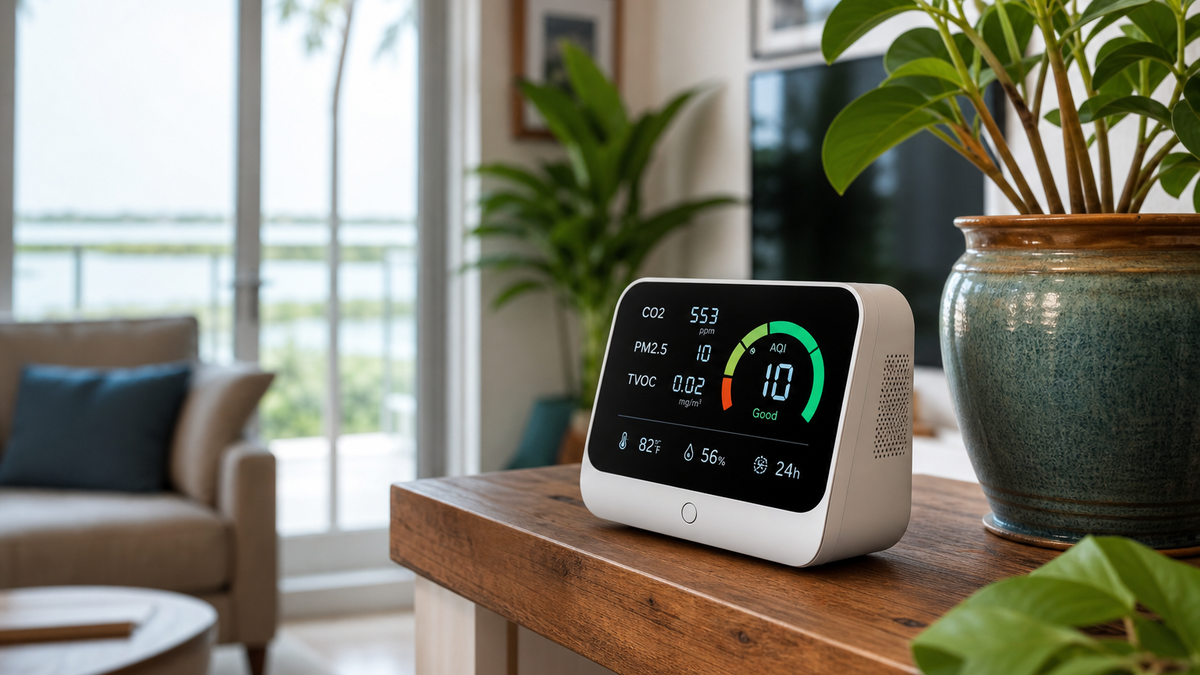
You can get a useful baseline of your home's air quality with two tools that cost less than $200 combined: a digital hygrometer and an indoor air quality monitor. For deeper concerns, a professional indoor air quality assessment from a licensed HVAC contractor adds tools and expertise homeowners do not typically have access to.
The targets we recommend for Florida homes:
- Relative humidity: 40 to 50 percent
- PM2.5 (fine particulates): under 12 micrograms per cubic meter (the EPA outdoor standard)
- CO2: under 1,000 ppm (a proxy for ventilation)
- VOCs: as low as your monitor can read, with no major spikes
Here is how the common testing options compare:
| Tool | Typical Cost | What It Measures | Best For |
|---|---|---|---|
| Digital hygrometer | $10 to $25 | Humidity and temperature | Every Florida home, room-by-room |
| Basic IAQ monitor | $80 to $200 | PM2.5, humidity, temperature, sometimes CO2 | Daily awareness, long-term trends |
| Premium IAQ monitor | $200 to $400 | PM2.5, VOCs, CO2, humidity, formaldehyde | Allergy or asthma households |
| At-home mold test kit | $20 to $50 | Mold spore presence (not species, usually) | Quick yes/no, not diagnostic |
| Professional mold inspection | $300 to $700 | Species identification, lab analysis | Suspected mold, real estate transactions |
| Professional IAQ assessment | $200 to $500 | Full system inspection, particulate count, humidity mapping | Persistent issues, new home, post-storm |
For most Pinellas County homes, a basic or premium IAQ monitor placed in the main living area gives you a year-round picture of how your air actually behaves. You will see humidity climb after a long shower, particulates spike during cooking, and CO2 rise during dinner with company. That awareness alone changes habits, and habits drive a meaningful share of indoor air quality outcomes.
If your monitor consistently shows humidity above 55 percent, PM2.5 above 12, or VOCs spiking and not recovering, you have moved past what DIY tools can solve. That is the point to bring in a professional, especially if anyone in the home has asthma or chronic allergies.
7 Practical Ways to Improve Indoor Air Quality in Florida
These are the seven upgrades and habits we install or recommend most often in Pinellas County homes, ordered roughly by impact per dollar spent. Start at the top and work down. Most homes do not need all seven. Two or three, chosen well, usually transform how the air feels.
Control Humidity Between 40 and 50 Percent
This is the single highest-impact lever in Florida indoor air quality. Below 50 percent, mold growth slows dramatically, dust mite populations crash, and the home feels noticeably cooler at any given thermostat setting. The challenge is that residential AC systems alone often cannot get indoor humidity below 55 to 60 percent in our climate, especially when systems are oversized and short cycle. A whole-home dehumidifier installed in the ductwork solves the problem permanently and runs independently of your AC. Portable dehumidifiers help in single problem rooms. For more on this, see our guide to reducing humidity in your house.
Upgrade to a MERV 11 or MERV 13 Air Filter
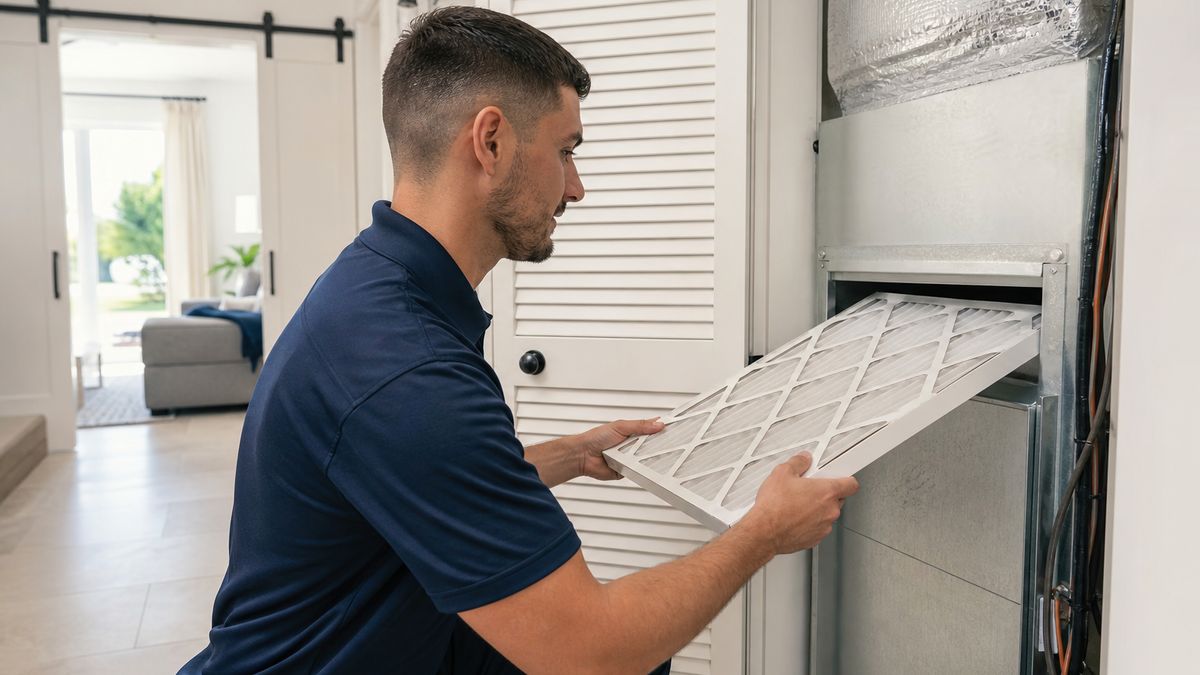
The Minimum Efficiency Reporting Value (MERV) of your filter determines how small a particle it can trap. Standard fiberglass filters rate MERV 1 to 4 and catch only large dust and lint. MERV 11 filters trap pollen, mold spores, pet dander, and most respirable dust. MERV 13 catches all of that plus most bacteria and many viruses. We do not recommend MERV 14 or higher in residential systems unless the equipment was specifically designed for them, because the airflow restriction can cause coil freeze-ups and compressor strain. In Florida's dust-heavy environment, replace pleated filters every 60 to 90 days, more often during pollen peaks or post-storm.
Add UV-C Lights and Whole-Home Air Purifiers
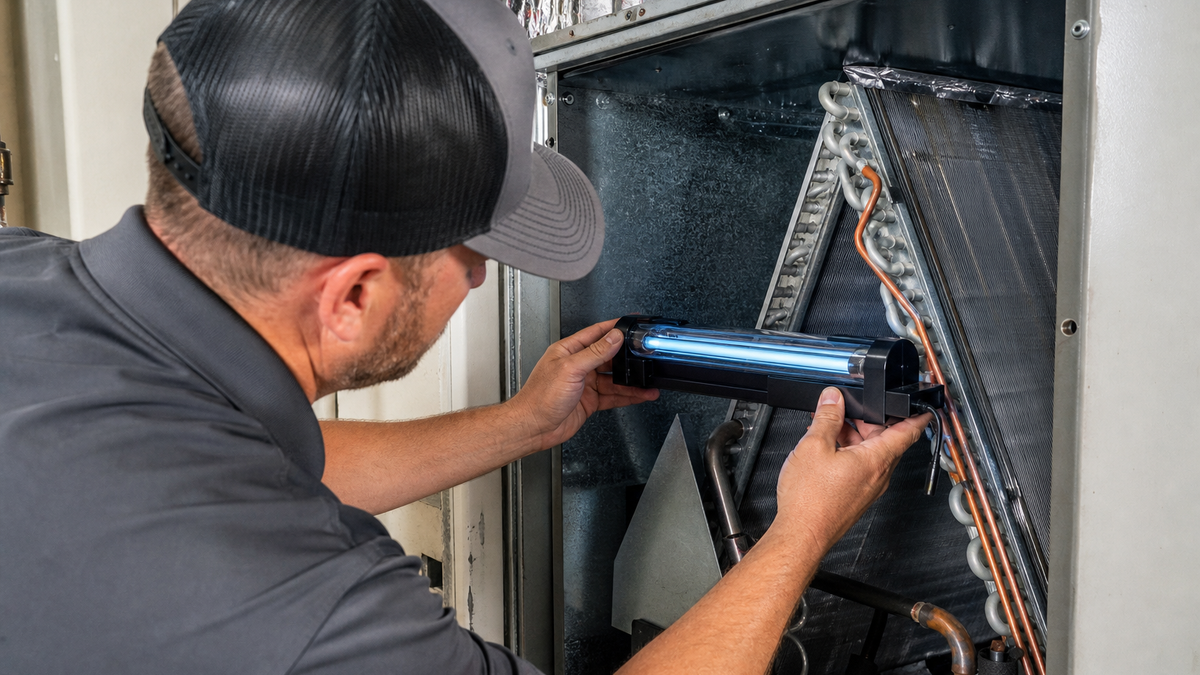
UV-C lights installed near the evaporator coil kill mold, bacteria, and viruses that try to grow on the wet coil surface, the single most consistent source of biological contamination in a Florida AC system. UV-C does not disinfect the air passing through (the contact time is too short), but it keeps the coil and drain pan clean, which prevents mold from being recirculated. Whole-home air purifiers go further. HEPA bypass systems pull a portion of return air through a true HEPA filter. Electronic air cleaners use charged plates to capture particles. Photocatalytic oxidation (PCO) and bipolar ionization systems reduce VOCs and odors in addition to particles. Each has tradeoffs in cost, maintenance, and what they actually remove.
Service Your AC and Inspect the Ductwork
The HVAC system is the lungs of your home. A neglected one circulates the same dirty air over and over. An annual professional tune-up with coil cleaning, condensate line clearing, and blower inspection prevents the slow degradation that drags air quality down over years. Have your ducts inspected (not necessarily cleaned) every few years for visible mold, leaks, or rodent intrusion. The EPA does not recommend routine duct cleaning unless there is documented contamination, so do not let a sales pitch push you toward a service you may not need. For ongoing protection, see our AC maintenance guide.
Seal the Building Envelope Against Outdoor Humidity
Every gap in your home's exterior is a place where 75 percent humidity outdoor air pushes in. Sealing the building envelope reduces both your humidity load and the volume of pollen, dust, and particulates entering. Focus on weatherstripping at doors, caulking around window frames and plumbing penetrations, sealing the attic access hatch, and checking the dryer vent flap. A blower door test from an energy auditor finds leaks you cannot see, and many Florida utilities offer rebates for envelope improvements.
Increase Fresh-Air Ventilation With an ERV or HRV
Tightly sealed homes accumulate CO2, VOCs, and indoor pollutants because there is no fresh-air exchange. An Energy Recovery Ventilator (ERV) brings filtered outdoor air in while exhausting stale indoor air, and the heat exchanger transfers heat and moisture between the two streams so you do not undo your AC's work. ERVs are particularly well-suited to Florida because they reject incoming humidity. HRVs (without moisture transfer) are less appropriate here. ERVs typically cost $1,500 to $3,500 installed and pair well with whole-home dehumidifiers in tight new construction.
Choose Surfaces and Habits That Reduce Indoor Pollution
Hardwood, tile, and luxury vinyl plank floors hold less dust than carpet. Hard-surface furniture beats fabric for dander control. Vent your kitchen exhaust fan to the outside (not into the attic) and run it for the duration of any cooking that produces steam or smoke. Run bathroom exhaust fans during and 15 to 20 minutes after every shower. Switch to fragrance-free or low-VOC cleaning products, store paint and solvents in the garage rather than the house, and let new furniture air out in a garage for a few days before bringing it in.
Indoor Air Quality Equipment Compared: Which IAQ Solution Fits Your Florida Home
There is no single product that solves indoor air quality in Florida. The right setup depends on what your air is doing, what your budget is, and how much maintenance you are willing to do. Here is how the most common indoor air quality services and equipment stack up:
| Solution | Typical Installed Cost | What It Removes | Maintenance | Best For |
|---|---|---|---|---|
| MERV 13 filter swap | $20 to $40 per filter | Pollen, dander, mold spores, dust | Replace every 60-90 days | Every Florida home, fastest win |
| Portable HEPA purifier | $150 to $500 per room | Pet dander, smoke, fine particulates | Filter every 6-12 months | Bedrooms, single-room solutions |
| Whole-home media filter cabinet | $400 to $800 installed | Pollen, dander, dust, mold spores | Replace cartridge yearly | Allergy households, 4-inch filter upgrade |
| UV-C lamp at the coil | $400 to $900 installed | Coil-grown mold, bacteria | Bulb replacement every 1-2 years | Homes with persistent mildew odor |
| Whole-home air purifier (ionization or PCO) | $700 to $1,500 installed | Particles, VOCs, odors, microbes | Annual cell cleaning or bulb swap | Homes with VOC, smoke, or odor issues |
| Electronic air cleaner | $700 to $1,200 installed | Fine particles, smoke | Wash cells every 1-3 months | Smoking households, very fine dust |
| Whole-home dehumidifier | $1,500 to $2,500 installed | Excess humidity (mold prevention) | Annual filter, drain check | Most Pinellas County homes |
| ERV (energy recovery ventilator) | $1,500 to $3,500 installed | Stale air, CO2, indoor VOCs | Annual filter, core inspection | Tight new construction |
If you are building from scratch with a single budget, the high-leverage stack for a Florida home is: MERV 13 filtration, UV-C at the coil, a whole-home dehumidifier, and an ERV if the home is new and tight. That covers humidity, biological growth on the coil, particulates, and ventilation. Add a portable HEPA in the bedroom of anyone with chronic allergies as the final layer.
Indoor Air Quality and Your HVAC System: How They Work Together
Your air conditioner moves the entire volume of air in your home through the air handler every 15 to 30 minutes when running. Whatever happens at that air handler, dirty filter, mold on the coil, leaking ducts, condensate backup, gets blown into every room. That is why the largest IAQ wins in a Florida home come from the HVAC system itself, not from add-on devices.
A properly sized AC system that runs longer cycles at lower output removes more humidity than an oversized unit that short cycles. A clean evaporator coil condenses moisture out of the air efficiently. A clear condensate line drains that moisture away rather than letting it pool and grow biofilm. Sealed ducts deliver conditioned air to rooms instead of pulling humid air from the attic into the supply stream. Each of these is a maintenance and installation issue, not an air-purifier issue.
When we evaluate indoor air quality in Florida homes, the first thing we check is the existing HVAC system. Roughly half the time, the path to better air is fixing what is already there, not adding equipment. A tune-up that includes coil cleaning, drain line clearing, blower inspection, and a fresh filter often makes a measurable difference within a week. From there, targeted upgrades fill the remaining gaps.
For homeowners thinking about whether to add IAQ equipment now or wait for a system replacement, the answer usually depends on the age and condition of your current AC. If your system is in good shape and well maintained, layering UV-C, a media filter cabinet, and a whole-home dehumidifier on top is straightforward. If your system is more than 10 years old, struggling, or oversized, a replacement plus an integrated indoor air quality package usually delivers better results for similar money.
Frequently Asked Questions About Indoor Air Quality in Florida
What is the ideal indoor air quality for a home in Florida?
For most Florida homes, the targets are relative humidity between 40 and 50 percent, PM2.5 below 12 micrograms per cubic meter (matching the EPA outdoor standard), CO2 below 1,000 ppm as a ventilation proxy, and minimal sustained VOC readings on a consumer air quality monitor. Hitting all four simultaneously requires more than just an AC. You typically need humidity control, a MERV 11 or 13 filter, regular HVAC maintenance, and some form of fresh-air ventilation in tight homes. These targets are achievable for the average Pinellas County home with the right combination of equipment and habits.
How does Florida humidity affect indoor air quality?
Florida's outdoor humidity averages around 74 percent year-round, and that moisture is constantly trying to push into your home. When indoor humidity rises above 60 percent, mold begins to grow on damp surfaces within 24 to 48 hours, dust mite populations expand rapidly, and many bacteria and viruses survive longer in the air. High humidity also makes the home feel hotter at any given temperature because your skin cannot evaporate sweat. Controlling humidity between 40 and 50 percent is the single most important step in indoor air quality services for Florida homes.
What MERV filter rating is best for Florida homes?
MERV 11 to MERV 13 is the residential sweet spot for filtration without overloading the blower. MERV 11 catches pollen, mold spores, pet dander, and most respirable dust. MERV 13 captures all of that plus many bacteria and some viruses. We generally do not recommend MERV 14 or higher in residential systems unless the equipment was specifically designed for them, because the airflow restriction can cause the evaporator coil to freeze and the compressor to overheat. In Florida's heavy dust load, replace pleated filters every 60 to 90 days, more often during pollen peaks or after major storms.
Do air purifiers actually work in humid Florida homes?
They do, but only as part of a system that also controls humidity. An air purifier captures particles already in the air, but if your indoor humidity stays above 60 percent, mold continues to grow on surfaces and generate new spores faster than the purifier can remove them. The right approach for Florida is to control humidity first, install effective filtration second, then add specialized purifiers for VOCs, smoke, or persistent odors. A whole-home air purifier paired with a whole-home dehumidifier addresses the actual sources rather than chasing symptoms.
How often should I have my ducts cleaned in Florida?
Most homes do not need annual or even regular duct cleaning. The EPA's official guidance is to clean ductwork only when there is visible mold growth inside the ducts, evidence of vermin or insect infestation, or substantial debris that is visibly clogging registers. Routine duct cleaning provides minimal indoor air quality benefit in homes without those specific issues. Your filter does the day-to-day work of keeping debris out of the ducts, so consistent filter changes matter more than scheduled duct cleaning. If you do have a documented problem, hire a NADCA-certified contractor and ask for before and after photos.
Can poor indoor air quality cause health problems in Florida?
Yes, and the risk is amplified by our climate. Sustained mold exposure from elevated humidity can trigger asthma attacks, allergic reactions, and respiratory infections. Dust mites are a major asthma trigger and thrive in our humidity range. VOCs from cleaning products and building materials cause headaches, eye irritation, and long-term lung impact at high exposures. Carbon monoxide from gas appliances is a year-round concern. Children, older adults, and anyone with asthma or COPD are most affected. Improving indoor air quality is one of the most measurable things a Florida homeowner can do for the family's day-to-day health.
Breathe Easier in Your St. Petersburg Home
Indoor air quality in Florida is not solved with a single device or a single visit. It is the result of a few good decisions stacked on top of each other: keep humidity in range, filter aggressively but not so much that you choke the system, maintain the HVAC equipment that moves your air, seal the home against outdoor pollutants, and ventilate intentionally when you need fresh air.
Killian's Air Conditioning has been helping Pinellas County homeowners across St. Petersburg, Clearwater, Largo, Pinellas Park, Dunedin, Palm Harbor, Seminole, Safety Harbor, and Gulfport build IAQ systems that fit their homes, not generic packages. We are family-owned, EPA certified, NATE certified, and licensed Florida HVAC contractors (CAC1823158). Same-day service is available, and our team takes 24/7 emergency calls when something is wrong with your air.
If you are not sure where your home stands, we will start with an indoor air quality assessment that includes humidity mapping, a filter and coil inspection, ductwork review, and a written recommendation for what (if anything) to upgrade. No pressure, no scripted upsell, just a clear picture of what your air is doing and what it would take to fix it.
Call Killian's Air at (727) 591-4776 to schedule an indoor air quality assessment for your Florida home. Same-day appointments available throughout St. Petersburg and Pinellas County. Florida License CAC1823158. Life's a Breeze with Killian's Air.