


What Size AC Unit Do I Need? | AC Sizing Calculator Guide
If you're asking "what size AC unit do I need," the short answer is roughly 1 ton of cooling per 400-500 square feet in Florida. That's more cooling capacity than the national average because our heat and humidity demand it. A 2,000 sq ft home in St. Petersburg typically needs a 4-5 ton system, while a 1,200 sq ft home usually runs well on a 2.5-3 ton unit.
But square footage is just the starting point. Factors like insulation quality, window placement, ceiling height, and ductwork condition can shift your ideal size by a full ton in either direction. This guide walks you through the sizing process step by step so you can have an informed conversation with your HVAC contractor before spending $5,000-$12,000 on a new system.
How to Determine What Size AC Unit You Need
Every air conditioner is rated in tons or BTUs (British Thermal Units). One ton of cooling equals 12,000 BTU per hour. Residential systems typically range from 1.5 tons (18,000 BTU) to 5 tons (60,000 BTU).
The basic formula is simple: divide your home's square footage by 400-500 to get the approximate tonnage for a Florida home. Nationally, the rule of thumb uses 500-600 sq ft per ton, but that does not account for Florida's climate.
Here's why the Sunshine State is different. Our cooling season stretches 8-10 months. Humidity regularly exceeds 70%. Afternoon temperatures hit 90+ degrees for months on end. Your AC does double duty here, cooling the air and pulling moisture out of it.
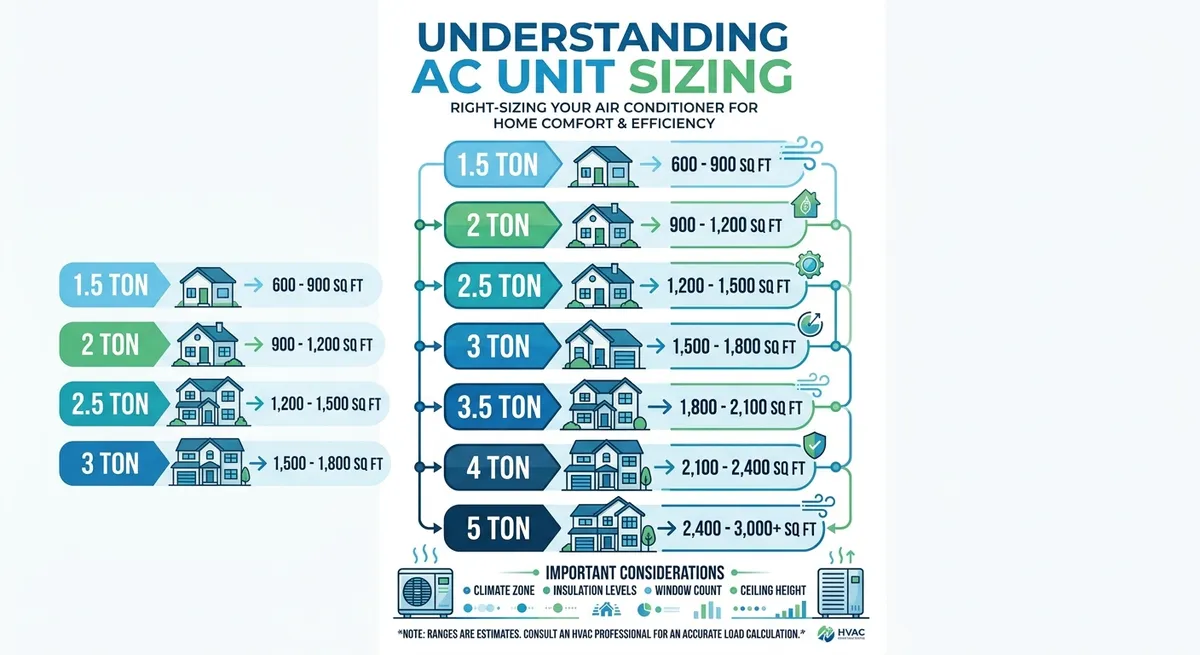
AC Unit Size Calculator: Tonnage by Square Footage Chart
Use this ac unit size calculator as a starting point for Florida homes. These ranges account for our subtropical climate but assume average insulation and standard 8-foot ceilings.
| Home Square Footage | Recommended Tonnage | BTU Capacity | Typical Home Type |
|---|---|---|---|
| 600 - 900 sq ft | 1.5 tons | 18,000 BTU | Small condo or apartment |
| 900 - 1,200 sq ft | 2.0 tons | 24,000 BTU | Smaller single-family home |
| 1,200 - 1,500 sq ft | 2.5 tons | 30,000 BTU | Average condo or townhome |
| 1,500 - 1,800 sq ft | 3.0 tons | 36,000 BTU | Mid-size single-family home |
| 1,800 - 2,100 sq ft | 3.5 tons | 42,000 BTU | Larger single-family home |
| 2,100 - 2,400 sq ft | 4.0 tons | 48,000 BTU | Spacious family home |
| 2,400 - 2,700 sq ft | 4.5 tons | 54,000 BTU | Large two-story home |
| 2,700 - 3,000+ sq ft | 5.0 tons | 60,000 BTU | Large estate or multi-zone home |
A quick note: these numbers reflect the cooled square footage, not total square footage. If you have an unfinished garage or unconditioned attic, don't count those areas.

How BTUs and Tons Are Connected
When shopping for an AC, you'll see both BTU and tonnage ratings on equipment labels. The conversion is straightforward:
- 1 ton = 12,000 BTU/hr
- 2 tons = 24,000 BTU/hr
- 3 tons = 36,000 BTU/hr
- 5 tons = 60,000 BTU/hr
Window units and portable ACs are usually rated in BTUs. Central air systems are rated in tons. If a contractor quotes you a "48,000 BTU system," that's a 4-ton unit.
Not Sure What Size AC Your Home Needs? We'll Calculate It for You.
Killian's Air Conditioning - Licensed & Insured
📞 (727) 591-4776Florida-Specific Factors That Change Your AC Size
The square footage chart above gives you a ballpark for what size AC unit you need, but several factors specific to Florida homes can push your sizing needs higher or lower. This is why two homes with identical floor plans can need different tonnage.
Humidity, Sun Exposure, and Insulation Quality
Humidity is the biggest wildcard in Florida AC sizing. Our average relative humidity hovers around 74% year-round. Your AC removes moisture as air passes over the evaporator coil, but it can only do this while the system is running. The right size unit runs long enough cycles to pull humidity down to a comfortable 45-55% indoors.
Sun exposure matters more than most homeowners realize. A home with large west-facing windows absorbs significantly more heat in the afternoon. If your home catches full afternoon sun, you may need to bump up by half a ton. Conversely, a well-shaded lot with mature tree cover may allow you to stay on the lower end of the sizing range.
Insulation quality varies widely across Pinellas County. Homes built before 1980 often have minimal attic insulation, sometimes as little as R-11, compared to the R-30 or higher recommended for Florida. Poor insulation means heat creeps into your home faster, and your AC has to work harder to compensate. If your home has older insulation and your AC struggles to keep up, upgrading insulation may be more cost-effective than oversizing your unit.

Ceiling Height, Windows, and Ductwork
Ceiling height directly affects the volume of air your AC needs to cool. Standard 8-foot ceilings are what most sizing charts assume. If your home has 9 or 10-foot ceilings, you're cooling 12-25% more air volume. Vaulted ceilings in a great room can add even more.
Windows are a major source of heat gain. Single-pane windows, common in older St. Petersburg and Clearwater homes, allow roughly twice the heat transfer of double-pane low-E windows. The number, size, and direction of your windows all factor into a proper load calculation.
Ductwork condition is the hidden factor many homeowners overlook. Leaky ducts can waste 20-30% of your cooled air before it reaches your living spaces. Undersized ducts restrict airflow, making even a correctly sized AC unit perform poorly. Before investing in a new system, have your ductwork inspected. A seasonal maintenance check often reveals duct issues that affect performance.
What Happens When Your AC Is the Wrong Size
Choosing the wrong AC size causes real problems, whether you go too big or too small. Here's how each scenario plays out in a Florida home:
| Factor | Oversized AC | Right-Sized AC | Undersized AC |
|---|---|---|---|
| Cycle Length | Short cycles (5-10 min) | Normal cycles (15-20 min) | Runs constantly |
| Humidity Control | Poor - not enough runtime to dehumidify | Good - removes moisture effectively | Fair - runs long but may not keep up |
| Energy Bills | Higher - frequent startups waste energy | Optimized - steady efficient operation | Higher - constant running drives up costs |
| Comfort | Uneven temps, cold spots near vents | Consistent temperature throughout | Hot spots in rooms far from the unit |
| Equipment Life | Shortened - cycling stress wears components | Full expected lifespan (15-20 years) | Shortened - constant strain causes early failure |
| Upfront Cost | $500-$2,000 more than needed | Appropriate for the home | May seem like a savings initially |
Oversized AC problems are especially harmful in Florida. When a unit is too large, it cools the air quickly and shuts off before running long enough to dehumidify. You end up with a house that feels cold and clammy at 74 degrees. Many homeowners then lower the thermostat further, wasting even more energy.
Undersized AC problems become most apparent during July and August, when Pinellas County temperatures stay above 90 degrees for weeks. An undersized unit runs all day, drives up your electric bill, and still cannot bring the temperature below 78-80 degrees by mid-afternoon.
The right size AC unit runs in 15-20 minute cycles, maintaining consistent temperature and humidity without wasting energy on excessive startups.
What SEER2 Ratings Mean for Your New AC
Once you know what tonnage you need, your next decision is efficiency. SEER2 (Seasonal Energy Efficiency Ratio 2) replaced the older SEER standard in January 2023. Higher SEER2 numbers mean lower operating costs.

Florida's minimum for new split-system air conditioners is 15 SEER2. You can find systems rated up to 22+ SEER2, though the price increases with each efficiency tier. Here's a rough comparison of annual cooling costs for a 3-ton system running in the St. Petersburg climate:
- 15 SEER2 (minimum): approximately $950-$1,100/year in cooling costs
- 17 SEER2 (mid-range): approximately $800-$950/year
- 20+ SEER2 (high-efficiency): approximately $650-$800/year
These estimates assume average electricity rates in the Tampa Bay area (roughly $0.13-$0.15/kWh) and typical usage patterns. Your actual costs depend on thermostat settings, home insulation, and local utility rates.
Size and efficiency are two separate decisions. A 16 SEER2 system that's properly sized will outperform a 20 SEER2 system that's the wrong tonnage. Always get the size right first, then choose the efficiency level that fits your budget.
When to Get a Professional Manual J Calculation
Online sizing charts and calculators give you a reasonable estimate of what size AC unit you need, but a Manual J calculation is the gold standard for AC sizing. Developed by the Air Conditioning Contractors of America (ACCA), Manual J is a room-by-room load calculation that accounts for every factor affecting your home's cooling needs.
A Manual J calculation considers:
- Square footage of each room
- Window sizes, types, and orientations
- Insulation R-values in walls, attic, and floors
- Number of occupants and heat-generating appliances
- Ductwork layout and condition
- Local climate data specific to your area
- Roof color and construction materials
You should get a Manual J calculation if:
- You're installing a brand-new AC system
- You're replacing an existing system and suspect it was the wrong size
- You've made major renovations (added rooms, replaced windows, added insulation)
- Your current system can't keep up with Florida summers or leaves your home feeling humid
Any reputable HVAC contractor should offer this as part of their installation process. At Killian's, our NATE-certified technicians perform load calculations before recommending a system size, because getting it right the first time saves you thousands over the life of the equipment.
Frequently Asked Questions About AC Sizing
What size AC do I need for a 2,000 square foot house in Florida?
A 2,000 sq ft home in Florida typically needs a 4-4.5 ton AC system. The national rule of thumb would suggest 3.5 tons, but Florida's heat and humidity push the requirement higher. Homes with poor insulation, lots of west-facing windows, or high ceilings may need to go to 5 tons. The best approach is a professional Manual J calculation, which factors in your specific home's construction and orientation rather than relying on square footage alone.
Can an oversized AC unit cause humidity problems?
Yes, and this is one of the most common comfort complaints we see in Pinellas County homes. An oversized AC cools the air so quickly that it shuts off before completing a full dehumidification cycle. The evaporator coil needs 10-15 minutes of continuous runtime to effectively pull moisture from the air. Short cycling from an oversized unit means your home may feel cold and clammy, and you might even notice condensation on windows or musty odors.
How do I know if my current AC is the wrong size?
Several signs suggest your AC may be the wrong size for your home. If your system runs for only 5-10 minutes before shutting off, it's likely oversized. If it runs nonstop during hot afternoons and still cannot reach your thermostat setting, it's probably undersized. Other clues include uneven temperatures between rooms, indoor humidity above 55%, unusually high electric bills, and frequent repair needs. A qualified technician can measure your system's performance and compare it to a proper load calculation.
What is a Manual J calculation and do I need one?
A Manual J calculation is the ACCA (Air Conditioning Contractors of America) standard method for determining exactly how much cooling and heating a home needs. It analyzes your home room by room, factoring in insulation, windows, orientation, occupancy, and local climate data.
You need one any time you're installing a new AC system or replacing an existing one. It costs between $100-$300 as a standalone service, though many HVAC companies include it free with an installation quote. Skipping this step is the top reason homeowners end up with the wrong size system.
Is it better to oversize or undersize an AC unit?
Neither is ideal, but if you had to choose, slightly undersized is less damaging in Florida. An undersized unit at least runs long enough to dehumidify your home, even if it struggles to hit 72 degrees on the hottest afternoons. An oversized unit short cycles constantly, leaving you with high humidity, uneven temperatures, and premature equipment wear.
The real answer is to get a proper load calculation and size it correctly. The cost of a Manual J calculation is minimal compared to living with the wrong system for 15 years.
How much does it cost to install the right size AC unit?
AC installation costs in the Pinellas County area generally range from $4,500 to $12,000+, depending on the tonnage, SEER2 rating, and complexity of the installation. A basic 2.5-ton, 15 SEER2 system falls on the lower end, while a 5-ton, 20 SEER2 system with ductwork modifications will be on the higher end.
Additional factors include whether you need a new air handler, thermostat upgrades, or duct sealing. Always get at least two to three quotes and make sure each contractor is performing a load calculation rather than just matching your old system's size.
Get the Right Size AC for Your Pinellas County Home
Choosing what size AC unit you need comes down to three steps: start with the square footage chart, adjust for Florida-specific factors like humidity and sun exposure, and confirm with a professional Manual J calculation. Getting the size right protects your comfort, your energy bills, and your equipment investment for the next 15-20 years.
Whether you're in St. Petersburg, Clearwater, Largo, or anywhere in Pinellas County, Killian's Air Conditioning can help you find the right fit. Our EPA and NATE-certified technicians perform a full load calculation before recommending any system, so you get the right size the first time.
Call Killian's Air Conditioning at (727) 591-4776 to schedule your free AC sizing consultation. Life's a Breeze with Killian's Air. License #CAC1823158.